-
 Обзорная экскурсия по Венеции 1 × €8.49
Subtotal: €8.49

Subtotal: €8.49

Gothenburg has one of the most distinctive food identities of any city in Scandinavia — and it’s not primarily about Michelin stars, though it has those too. It’s about a city that takes everyday eating seriously: the fish market that’s been running since 1874, the Thursday soup tradition that goes back centuries, the cardamom bun that’s as central to Gothenburg life as a morning commute. Eating here is a genuine window into how the city works.
This guide covers what you actually need to know before you eat your way through Gothenburg: the dishes worth seeking out, the markets and venues worth visiting, the cultural rituals that frame Swedish food, and the practical logistics of eating well without spending a fortune.
Almost all of it sits within walking distance in the old centre, which is why so many visitors pair it with the TouringBee Gothenburg audio guide — the route runs past Feskekörka, Saluhallen and the Haga cafés, so the food stops and the history land in the same afternoon. Whether you have one day or five, the food will be a highlight if you approach it with a little context.
Two facts shape Gothenburg’s food identity more than any others. First: the city is Scandinavia’s largest port, with direct access to some of the best seafood in the world. Prawns, herring, cod and mackerel move through here in volumes that would make most coastal cities envious, and the freshness shows up on every plate. Second: the city was founded in 1621 as a trading hub, drawing Dutch, German, Scottish and Swedish merchants who each brought food traditions with them. The result is a city that absorbed outside influences without losing its local character — practical, unpretentious, quietly excellent.
That character shows up in how Gothenburg eats. There’s an emphasis on seasonal and local produce that long predates the current trend for it. Fika — the daily coffee-and-pastry ritual — isn’t a marketing concept here; it’s a genuine break that structures the day. And the Thursday pea soup tradition, observed in homes, offices and restaurants across the city every week, is the kind of stubborn cultural habit that tells you more about a place than any guidebook paragraph can.
If you’re in Gothenburg and you don’t eat seafood, you’ve made a real mistake. The city sits at the mouth of the Göta Älv, with the North Sea close and the archipelago just beyond the harbour, so the catch is as fresh as it gets in Sweden. West coast prawns (räkor) are the classic: large, sweet, served cold with dill and bread and eaten slowly over a long lunch. Locals buy them by the bag at the harbour and eat them on the docks — cheaper and more atmospheric than most restaurants.
Herring (sill) appears in more forms than most visitors expect: pickled with mustard, with red onion, with cream, with lingonberry. It’s served as part of a smörgåsbord, as a standalone starter, or on crispbread. Cod (torsk) and mackerel (makrill) show up on seasonal menus. In late summer and autumn, look for fresh-caught crayfish (kräftor) — a Swedish seasonal obsession that comes with its own party format.
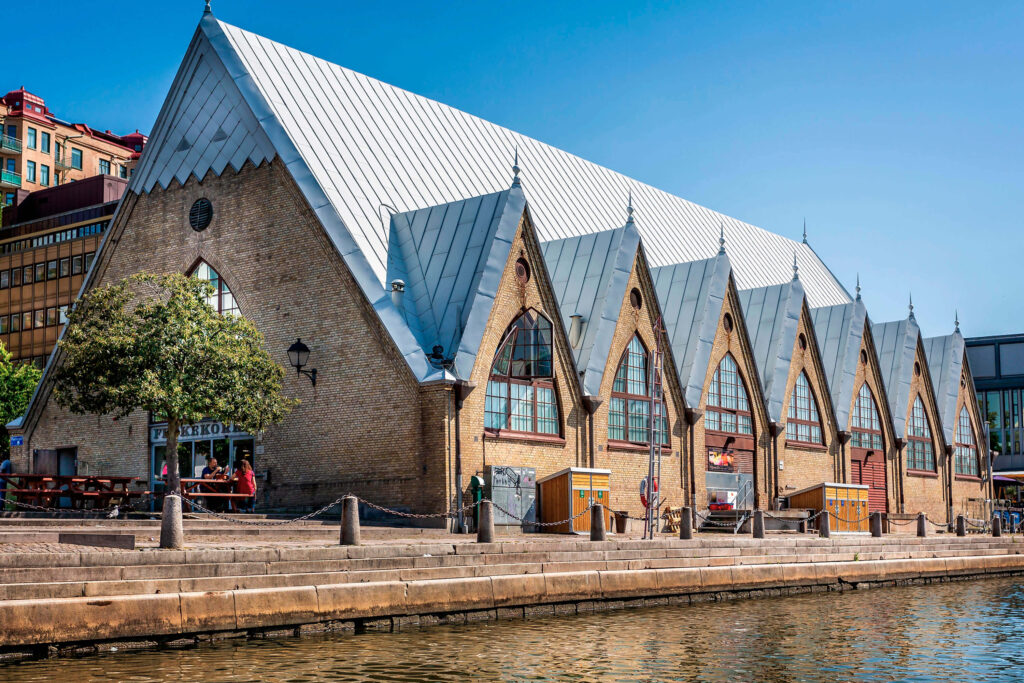
The Feskekörka, or “Fish Church”, is Gothenburg’s most famous food venue and one of its most photographed buildings. Built in 1874 in Gothic Revival style — lancet windows, pointed arches, a façade that genuinely resembles a small cathedral — it was put up to solve a practical problem: outdoor fish markets in summer heat were becoming a public health issue. The solution was this elegant indoor hall on the bank of the Rosenlundskanalen.
Inside you’ll find some of the best fish and shellfish in the city, sold from stalls that have been trading here for generations. The restaurant upstairs, Gabriel, is worth a visit for a seafood lunch. Arrive before noon for the best selection; the market typically closes around 3pm. The building alone justifies the walk, even if you’re not buying.

Husmanskost translates roughly as “farmer’s food” or “home cooking” and describes the backbone of traditional Swedish cuisine: hearty, seasonal, economical, deeply satisfying. In Gothenburg’s older restaurants and lunchtime locals you’ll find the real thing: meatballs with lingonberry and creamed potatoes, Jansson’s temptation (a gratin of potatoes, onions and pickled sprats), beef Rydberg (diced beef with mustard and egg yolk), and falukorv (a mild pork sausage eaten at home and in school canteens across Sweden).
The best husmanskost in Gothenburg is served at lunchtime, usually for a set price that includes bread, salad, a main and coffee. Look for the dagens lunch (daily lunch) boards outside traditional Swedish restaurants; it’s how many locals eat on working days and it’s excellent value.
Every Thursday, restaurants and home kitchens across Sweden serve yellow pea soup with pork (ärtsoppa), followed by pancakes with cream and jam. This isn’t a regional quirk — it’s a national habit, observed consistently enough that you can walk into virtually any traditional restaurant on a Thursday and find it on the menu. The origin is disputed (some trace it to medieval fasting practices), but the ritual has survived intact into the 21st century, which says something about Swedish attachment to food traditions.
If you’re in Gothenburg on a Thursday, eat the pea soup. It’s warming, filling and cheap, and having it puts you in rhythm with the city in a way that ordering off the à la carte doesn’t.
Every city has a street food that’s more or less its own, and Gothenburg’s is the Halv Special: a hot dog (varm korv) in a bun, topped with mashed potato, prawns in mayonnaise and red onion. The name refers to a half portion, which suggests the full version was once even more substantial. You’ll find it at hot dog stands (korvkiosker) across the city. It isn’t a tourist affectation — locals eat it, students eat it, it turns up at football grounds and late-night corners in equal measure. Try it at least once.
Surströmming is fermented Baltic herring, left in barrels for six months until it reaches a pungency that has been compared — not kindly — to a number of unpleasant things. It’s a genuine Swedish tradition, primarily associated with northern Sweden, and it has a devoted following. The correct way to open a can is underwater, to stop the brine spraying. It’s eaten on thin crispbread with onion, sour cream and new potatoes.
You won’t find it in most Gothenburg restaurants. But you will find it in specialist food shops, and mentioning it to a Swede will reliably generate an opinion. The cultural significance is real even if the eating experience is, for most visitors, optional.
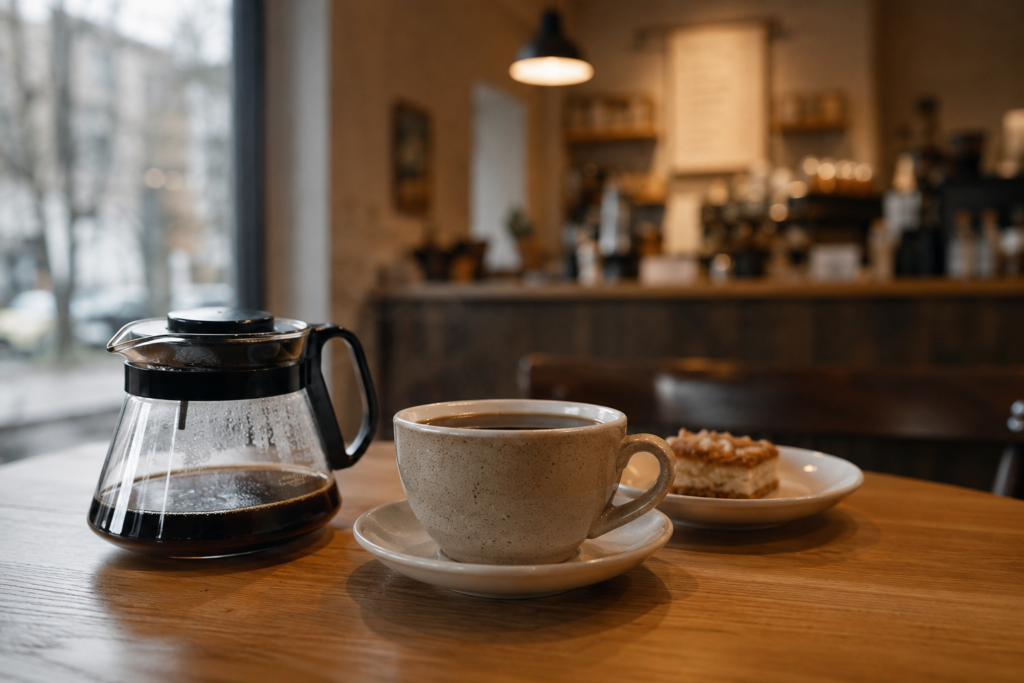
Fika deserves its own section because it isn’t just a food habit — it’s a social institution that structures Swedish daily life in a way that genuinely surprises visitors. Twice a day, roughly mid-morning and mid-afternoon, Sweden stops for coffee and something sweet. In offices this is a scheduled break. In cafés it’s the default activity. In homes it’s how you receive a guest. Refusing fika when it’s offered is a mild social offence.
The food involved is typically a cinnamon bun (kanelbulle) or a cardamom bun (kardemummabulle), though the full range of Swedish baking — cardamom twists, almond pastries, kladdkaka (sticky chocolate cake), princess cake (prinsesstårta) — all qualifies. The coffee is strong and usually comes with a free refill called a påtår, a custom that makes Gothenburg cafés better value than they first appear. If you want the full background, we’ve covered the ritual in detail in Swedish fika explained.

Haga is the neighbourhood most associated with fika culture here, and for good reason: the main street, Haga Nygata, is lined with cafés that have been baking cinnamon buns for decades. The buns are notably larger than average — some the size of a side plate — and the atmosphere in the old landshövdingehus buildings is genuinely warm. Go mid-morning on a weekday to avoid weekend queues. If you’d rather have it organised for you, there’s a well-reviewed guided walk through the old town that builds in a proper fika stop.
Saluhallen, the covered food market near Haga, is another excellent option: stalls selling coffee, pastries, cheese, bread and charcuterie in a covered 19th-century hall. It’s both a fika destination and a good place to pick up provisions for a picnic.
| Tradition | What It Is | When/Where You’ll Encounter It |
|---|---|---|
| Fika | Coffee break with a pastry or bun, twice daily | Every café, every workplace, most homes |
| Ärtsoppa | Yellow pea soup with pork, followed by pancakes | Every Thursday at traditional restaurants |
| Smörgåsbord | A spread of cold and hot dishes, self-served buffet style | Festive occasions, some hotel breakfasts |
| Påtår | Free coffee refill — offered automatically at many cafés | Traditional Swedish cafés |
| Midsommar food | Pickled herring, new potatoes, strawberries and cream | Midsummer (late June) celebrations |
| Julbord | Christmas table — gravlax, herring, meatballs, rice pudding | December |
| Kräftskiva | Crayfish party — seasonal eating with party hats and schnapps | Late summer (August–September) |

Feskekörka. The fish market that defines the city’s seafood identity. Open Tuesday–Saturday, closing around 3pm; best visited before noon. The upstairs restaurant Gabriel is well regarded for seafood lunches.
Saluhallen. The covered indoor market near Haga, with stalls selling cheese, smoked meats, bread, pastries, coffee and Swedish specialty foods. A good rainy-day alternative to outdoor markets and an excellent source of picnic supplies. Open Monday–Saturday.
Haga. The old dockworkers’ neighbourhood that has become Gothenburg’s fika capital. The cafés on Haga Nygata are the best known, but the side streets have smaller, quieter spots that locals prefer. Budget 30–45 minutes; don’t rush it.
Avenyn and Linné. Kungsportsavenyn (Avenyn) has a high density of restaurants — some excellent, some average, at tourist-facing prices. For better value and more local atmosphere, walk a few blocks west to Linnégatan and the Linné neighbourhood, where independent restaurants and wine bars offer more food per krona.
| Meal | What to Order | Where | Approx. Cost (per person) |
|---|---|---|---|
| Breakfast | Filmjölk with muesli, open sandwich, or coffee and a bun | Hotel, café or Saluhallen | €5–10 |
| Fika (mid-morning) | Cardamom or cinnamon bun + coffee (with påtår) | Haga cafés | €5–8 |
| Lunch | Dagens lunch — soup, main, bread, coffee | Traditional lunch restaurants | €12–16 |
| Seafood lunch | Prawn sandwich, seafood plate or herring board | Feskekörka (Gabriel), harbour kiosks | €15–25 |
| Street food | Halv Special hot dog | Korvkiosk around the city | €4–6 |
| Dinner | West coast fish, meatballs or a seasonal Swedish menu | Linné neighbourhood restaurants | €25–45 |
| Late evening | Kebab, pizza, or a second Halv Special | Central late-night spots | €8–12 |
Costs stack up quickly in Sweden, so if you’re watching the budget it’s worth reading our notes on travelling really cheap and on affordable experiences that still feel generous — both apply neatly here. Gothenburg also has plenty of free things to do to balance out the eating.
| Mistake | The Better Option |
|---|---|
| Eating every meal on Avenyn (tourist prices, mixed quality) | Walk five minutes west to Linné for better food at lower prices |
| Skipping fika because “it’s just coffee and a bun” | Build a proper fika stop into your day in Haga — it’s one of the experiences |
| Ignoring the Thursday pea soup if you’re there on a Thursday | Order the ärtsoppa — cheap, authentic and delicious |
| Arriving at Feskekörka after 2pm | Go before noon for full selection and a possible lunch at Gabriel |
| Eating only dinner and skipping Swedish lunch | Eat the dagens lunch — the best-value meal of the day in most traditional restaurants |
| Not trying the Halv Special because it sounds odd | Try it once — it’s genuinely good, and specifically Gothenburg |
Gothenburg has a serious fine dining scene — more Michelin stars per capita than Stockholm, by some counts — but covering it in depth is beyond the scope of a general food guide. What’s worth knowing: the city’s top restaurants, clustered around the centre and the harbour district, tend to focus on West Coast Swedish ingredients cooked with French or Nordic technique. For most visitors on a one- or two-day trip, the everyday food — fika, seafood at Feskekörka, husmanskost, the Thursday soup — is more representative and more memorable than the tasting-menu tier. The city’s real food identity lives in its markets and its rituals.
Gothenburg’s food is inseparable from its geography. Most people do the audio guide as a morning walk, build in a lunch stop at Feskekörka around noon, and finish with fika in Haga mid-afternoon — which covers both the food highlights and the historical context behind them. If you’d rather plan the whole day at once, our one-day Gothenburg itinerary and the broader what to see in Gothenburg guide both slot around these meals.
Gothenburg is most famous for its seafood — particularly West Coast prawns, herring in various preparations, and the Feskekörka fish market. Locally, the cinnamon and cardamom buns in Haga and the Halv Special hot dog are distinctly Gothenburg foods that don’t travel well to other cities.
Sweden is expensive by most European standards, but Gothenburg is somewhat more affordable than Stockholm. Lunch at a traditional restaurant (dagens lunch) typically costs €12–16 including coffee. A fika stop is €5–8. A seafood lunch at Feskekörka runs €15–25. Budget travellers who use the lunch deal, treat fika as their snack and browse Saluhallen can eat well for €30–40 a day.
Start with fika in Haga (cardamom bun and coffee). Walk to Feskekörka for a seafood lunch — the prawn sandwich or a herring board. Snack on a Halv Special at a korvkiosk in the afternoon. If it’s Thursday, find a traditional restaurant for the pea soup. That covers the essential Gothenburg food experiences in roughly the same order as the city’s geography.
Traditional Swedish food is heavily meat- and fish-based, but Gothenburg’s restaurant scene is well adapted to vegetarian and vegan diets. Most modern restaurants offer good plant-based options. If you’re vegan, research specific restaurants in advance; Linnégatan has several strong choices.
Fika is a coffee break with a pastry or bun, observed twice daily across Sweden. To do it properly: sit down, don’t rush, and treat it as a social pause rather than a grab-and-go moment. Order a coffee and a cinnamon or cardamom bun. Accept the påtår (free refill) if it’s offered. Spend at least 20 minutes. In Gothenburg, the best fika is in Haga.
Saluhallen is the best source of takeaway food: cheese, smoked salmon, charcuterie, bread and pastries, all from individual stalls. Feskekörka sells fresh and smoked fish. Harbour kiosks near Stenpiren sell prawn bags and sandwiches traditionally eaten on the docks. Sweden’s allemansrätten (right of public access) makes outdoor eating easy and natural.
Disclosure: this article contains affiliate links. TouringBee audio guides are our own product, and we earn a commission on bookings made through GetYourGuide links at no extra cost to you.

