
No products in the cart.

One Day in Gothenburg: The Perfect Itinerary for a Quick City Break
Gothenburg rarely gets the headline slot in a Scandinavia trip. Stockholm gets the postcards, Copenhagen gets the design blogs, and Gothenburg gets squeezed into a layover or a single rushed afternoon. That’s a shame, because Sweden’s second city packs an unusual amount of history, food culture, and walkable charm into a center small enough to cover on foot in a single day.
The good news is that one day in Gothenburg is genuinely enough to come away with a real sense of the place, not just a checklist of photos. The historic core sits inside what used to be a 17th-century fortress, which means almost everything worth seeing is within a 30-minute walk of almost everything else.
While mapping out TouringBee self-guided Gothenburg walking route, we kept running into the same problem: most “one day in Gothenburg” itineraries online are just a list of attractions with no sense of order, pacing, or why any of it matters. So this guide does something different. It gives you a realistic hour-by-hour plan, explains what each stop is actually worth your time for, and flags the places people regularly skip and later regret skipping.
At a Glance: Is One Day Really Enough?
Short answer: yes, for the highlights. Longer answer: it depends what “seeing Gothenburg” means to you.
| If you have… | You can realistically do |
|---|---|
| Half a day (4-5 hours) | The historic core: Gustaf Adolfs Torg, the canals, the Cathedral, Haga, and a fika break |
| One full day (8-10 hours) | The full historic core plus Avenyn, Götaplatsen, one museum, and a viewpoint like Skansen Kronan |
| One day, fast-paced | All of the above plus a quick stop at Feskekörka and Saluhallen for lunch |
| Two days | Everything above, unhurried, plus Liseberg, the Volvo Museum, or a half-day on the archipelago |
If you’re working with exactly one day, the itinerary below is built to fit comfortably into roughly nine hours, including two food stops, without ever feeling like a forced march. It’s designed for visitors arriving by cruise ship, on a stopover between Stockholm and Copenhagen, or simply choosing to base a longer Sweden trip elsewhere and treat Gothenburg as a single deliberate day out.
Before You Start: Quick Planning Checklist
A little prep makes a one-day visit feel relaxed instead of rushed.
- Wear flat, broken-in walking shoes — the center is compact but cobblestoned in places.
- Check the weather the night before; Gothenburg’s coastal location means wind and quick weather changes even in summer.
- Download an offline map or a self-guided walking app before you arrive, since not every street has reliable signage.
- Decide in advance whether you want to pay for any museum entry, so you’re not making that decision on the spot and losing time.
- Bring a reusable water bottle — tap water is excellent and free refill stations are common.
Getting to Gothenburg and Getting Around
Most visitors arrive either through Landvetter Airport, about a 25-30 minute bus ride from the city center, or by train into Gothenburg Central Station, which sits right at the edge of the historic core. Either way, you’ll likely pass through Brunnsparken, the city’s busiest transit hub and a useful mental landmark for the rest of the day.
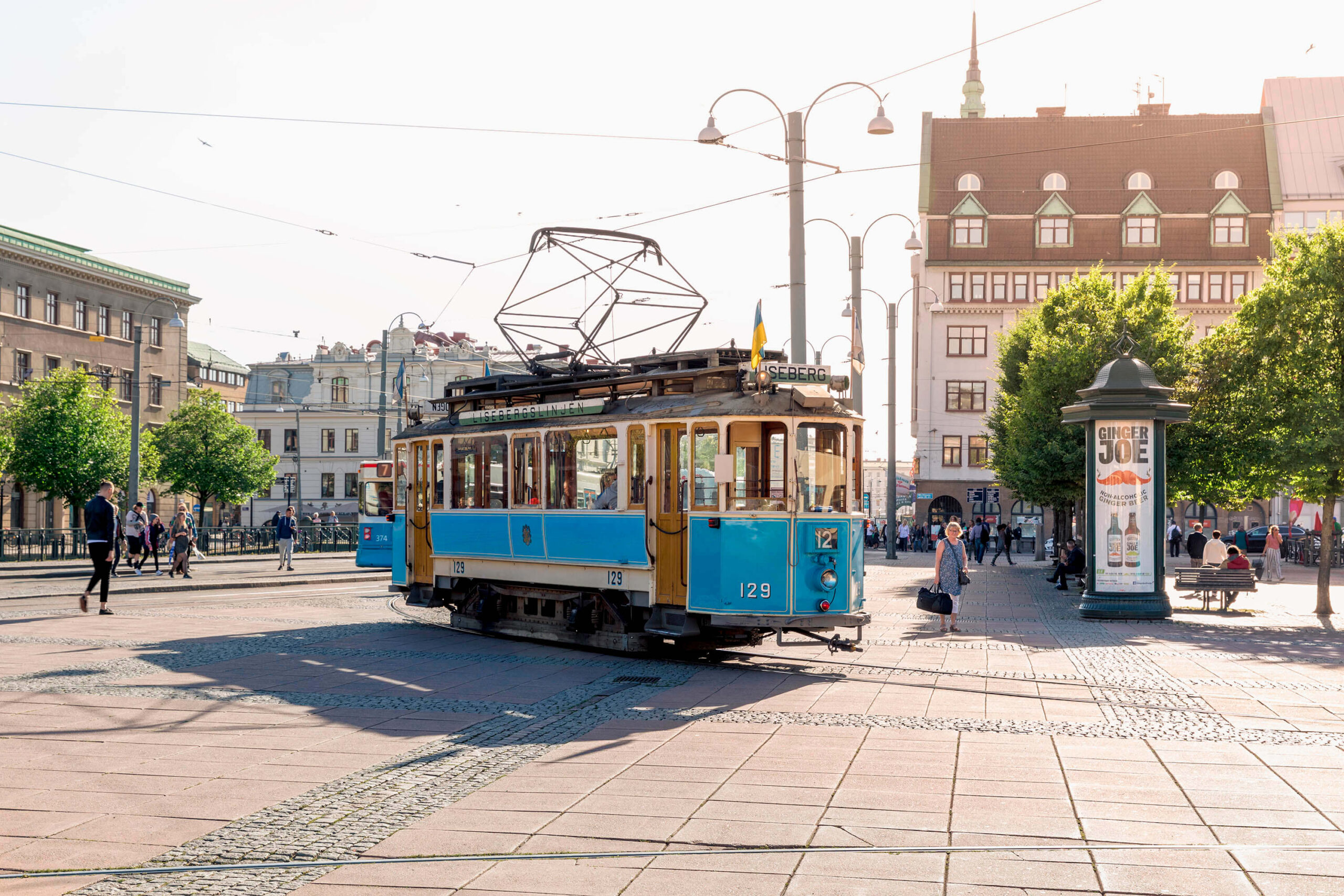
Gothenburg has run trams since 1879 and operates the largest tram network in Scandinavia, so public transport is rarely the bottleneck here — the itinerary below is simply more interesting on foot. If you do want to hop on a tram at any point, lines 5 and 10 or buses 18 and 25 connect Brunnsparken with Gustaf Adolfs Torg in a few minutes.
If your one day happens to include a museum visit or two, look into the Gothenburg Pass before you go. It bundles entry to more than 20 attractions, plus some water tours, and can work out cheaper than paying for individual tickets — though for a single museum stop, as in this itinerary, paying as you go is usually simpler.
The Easiest Way to Structure the Day
Here’s the part most “one day in Gothenburg” guides skip: you don’t actually need to plan this hour by hour yourself. Our self-guided Gothenburg City Walking Tour covers almost this exact route through the old center in about three hours of walking and listening time, and in practice that’s exactly how most people end up using it for a one-day visit — not as a separate “extra” activity, but as the spine the whole day is built around.
The pattern is simple, and it’s the one reflected again and again in how people actually review the tour afterward: start the route in the morning, pause once partway through for a museum stop, and pause twice more for food — once for fika, once for lunch — using the cafés and food spots the route already passes near. Finish the route, and you’ve effectively completed the itinerary below without having to stitch it together from scratch.
The One-Day Gothenburg Itinerary
This route starts at Gustaf Adolfs Torg, the square widely treated as the symbolic center of the city, and ends near Skansen Kronan, a hilltop fortress with the best skyline view in town. It’s also, not coincidentally, very close to the route covered by our self-guided Gothenburg walking tour mentioned above, because this sequence simply makes geographic sense — you’re rarely backtracking. Think of the table below as that same three-hour route broken into a specific clock-time schedule, with the museum stop and two food breaks slotted in.
| Time | Stop | Suggested Duration |
|---|---|---|
| 9:00 | Gustaf Adolfs Torg & City Hall | 20-25 min |
| 9:30 | The canals & Kronhusbodarna courtyard | 30-40 min |
| 10:15 | Gothenburg Cathedral | 15-20 min |
| 10:45 | Feskekörka (the Fish Church) | 15-20 min |
| 11:15 | Haga district + fika break | 60-75 min |
| 12:45 | Walk to Avenyn | 15 min |
| 13:00 | Kungsportsavenyen (“Avenyn”) + lunch | 60 min |
| 14:15 | Götaplatsen & the Poseidon statue | 20 min |
| 14:45 | Gothenburg Museum of Art (optional) | 45-60 min |
| 16:00 | Vasa district & University of Gothenburg | 20-30 min |
| 17:00 | Skansen Kronan viewpoint | 20-30 min |
Morning: Gustaf Adolfs Torg to Feskekörka
Start at Gustaf Adolfs Torg, the square named for the Swedish king who personally chose this site to found a new city in 1621. The statue at its center marks where, according to local legend, the king decided this swampy stretch of riverbank was the right place for a fortified trading town — a decision that put Gothenburg on a permanent collision course with Dutch engineers, who were the only ones willing to build on such unstable ground.
From the square, walk toward Gothenburg’s canal system, which the Dutch designed in the 1600s using the same techniques they used at home in cities like Amsterdam. The canals aren’t just decorative; they’re the reason the city’s street grid looks the way it does, and a slow walk alongside them is one of the best free things to do in the city center.
Detour briefly to Kronhusbodarna, the oldest secular courtyard in Gothenburg, tucked behind the old armory building. Outside the Christmas season it’s a quiet spot with small craft workshops; in late November and December it transforms into one of the city’s most atmospheric Christmas markets.
Gothenburg Cathedral sits a short walk away and costs nothing to enter. It’s modest compared to the grand cathedrals of continental Europe, which is the point — Swedish Lutheran church interiors tend toward restraint rather than spectacle, and the building’s calm, unornamented interior says more about local sensibility than any plaque could.
End the morning loop at Feskekörka, the 19th-century fish market whose Gothic-revival architecture earned it a nickname that translates to “the Fish Church.” It was built to solve a genuinely unpleasant problem: before it existed, fish was sold outdoors along the canals, and the smell and spoilage were serious enough to be a public health issue. Today it’s as much an architectural curiosity as a working market.
Midday: Haga and the Art of Slowing Down
Haga is the neighborhood every “what to see in Gothenburg” list mentions, and it earns the attention. Built originally as housing for dockworkers outside the old fortress walls, it spent much of the 20th century as one of the city’s poorest and roughest districts — at one point slated for large-scale demolition. What saved it, somewhat accidentally, was a 19th-century building rule: wooden houses above two stories were banned after repeated fires, so builders compromised with a stone ground floor topped by wooden upper floors. Those hybrid buildings, still standing today, are now considered some of the most charming architecture in the city.
This is the right place to take your first proper break and do what locals do every single day: fika. If you only learn one Swedish word before visiting, make it this one. It isn’t simply “having coffee” — it’s a scheduled pause built into the rhythm of the day, usually with a pastry. Haga’s bakeries are known for cinnamon and cardamom buns roughly the size of a fist, and ordering a black coffee here often comes with an unadvertised perk: free refills, known locally as påtår.
| Haga Fika Checklist |
|---|
| ☐ Order a cinnamon or cardamom bun, not just a plain pastry |
| ☐ Ask if black coffee refills are included before assuming they’re not |
| ☐ Sit down for at least 15-20 minutes instead of taking coffee to go |
| ☐ Browse one antique shop or independent boutique while you’re there |
Afternoon: Avenyn, Götaplatsen, and the Museum of Art
From Haga, walk toward Kungsportsavenyen, known to locals simply as Avenyn — Gothenburg’s grand 19th-century boulevard and the natural place for lunch, with restaurant terraces lining both sides of the street.
Avenyn leads directly to Götaplatsen, home to the city’s most photographed and most argued-about landmark: the Poseidon statue. When sculptor Carl Milles installed it in the early 20th century, the reaction from locals was not gratitude. Complaints ranged from the figure’s disproportionate legs to, more famously, the size of certain anatomical details — details Milles reportedly had to scale back after objections from the city’s more conservative residents. A century of running jokes later, the statue is regularly dressed up in costumes for holidays and has become one of the most reliable meeting points in the city.
If you have an hour to spare, the Gothenburg Museum of Art sits right on the square. It holds an unusually strong collection for a city this size, including a homegrown early 20th-century movement known as Göteborgskoloristerna — a group of painters who studied under an instructor who had himself trained under Henri Matisse, and who treated color as more important than form. The museum rarely feels crowded, which means you can actually look at the paintings rather than navigate around tour groups.
Late Afternoon: Vasa District and the View From Skansen Kronan
Heading away from Götaplatsen, the Vasa district is home to the University of Gothenburg and a 19th-century church of the same name. It’s a quieter, more residential stretch — a good contrast after the museum crowds — and a reminder that the city’s identity isn’t only about its waterfront. The university itself, founded in 1891, has a surprisingly outsized academic reputation for a city this size: its graduates and faculty include a Nobel laureate in medicine and members of the committee that awards the Nobel Prize in Literature.
This stretch of the city also borders Vasagatan, a wide boulevard that becomes the stage for one of Gothenburg’s more eccentric annual traditions every spring, when costumed students parade down it on decorated floats. You won’t see that on a random Tuesday in October, but the street itself is worth a glance for its grand 19th-century townhouses even without the spectacle.
Finish the day at Skansen Kronan, a 17th-century hilltop fortress originally built to defend the city and now mostly used for private events. You can’t typically go inside, but the walk around its base gives you the best wide-angle view of central Gothenburg available without paying for a tower or boat tour — a fitting way to see, all at once, the route you just walked.
What to Skip If You’re Running Short on Time
One day always involves trade-offs. Here’s a quick guide to what to cut first if your schedule gets squeezed.
| Cut This First | Keep This Instead | Why |
|---|---|---|
| A second museum | Haga + fika break | The neighborhood experience is harder to replace than any single collection |
| A sit-down lunch on Avenyn | A quick stop at Saluhallen food hall | Faster, and arguably more representative of everyday Gothenburg food |
| Feskekörka if it’s closed (Mondays) | An extra 15 minutes at the canals | The market is shut on Mondays in many seasons — check ahead |
| Skansen Kronan | Götaplatsen at golden hour | Both are good viewpoints, but Götaplatsen needs zero extra walking |
What a One-Day Visit Roughly Costs
Budgets vary a lot by travel style, but here’s a realistic range for the itinerary above, assuming you skip overnight accommodation and look only at the day itself.
| Expense | Budget Estimate | Mid-Range Estimate |
|---|---|---|
| Two fika stops (coffee + pastry) | €8-10 | €14-18 |
| Lunch on Avenyn or at Saluhallen | €10-14 | €20-30 |
| Museum of Art entry (optional) | €0-12 depending on current pricing/free days | Same |
| Local transit (if used at all) | €3-5 per single ticket | €12-15 for a day pass |
| Total for the day | Roughly €20-35 | Roughly €45-65 |
The single biggest cost lever is whether you add a paid museum and how much you spend on lunch — the rest of this itinerary, from the canals to Skansen Kronan, costs nothing beyond your own time.
Practical Tips for a One-Day Visit
✔ Start before 9:30 if possible — Gothenburg’s center gets noticeably busier with both locals and tour groups by midday.
✔ Public transit (trams especially) is excellent, but for this particular route you genuinely won’t need it — everything connects on foot.
✔ Carry coins or have a contactless card ready; some smaller cafés and market stalls in Feskekörka and Saluhallen don’t take all card types.
✔ If the weather turns, the Museum of Art and Feskekörka both work as solid indoor fallbacks.
✔ Build in slack. The single biggest mistake in one-day itineraries isn’t seeing too little — it’s scheduling so tightly that you can’t enjoy any of it.
Common Mistakes First-Time Visitors Make
Treating Gothenburg Like a Smaller Stockholm
Gothenburg isn’t trying to be a miniature capital city. Its appeal is in the canals, the seafood culture, and the unhurried pace — not in palaces or royal pageantry. Visitors who arrive expecting Stockholm-in-miniature often miss what actually makes Gothenburg distinct.
Skipping Fika Entirely
It’s tempting to treat a coffee break as wasted sightseeing time. In Gothenburg, fika is part of the sightseeing — it’s a genuine slice of daily Swedish life, not a tourist add-on.
Not Checking Feskekörka’s Opening Days
The fish market has historically closed on Mondays. Showing up on the wrong day for the one stop you were most looking forward to is an easy and avoidable disappointment.
Over-Packing the Itinerary
Trying to add Liseberg, the Volvo Museum, and an archipelago boat trip onto a single day usually means seeing none of them properly. Those belong on a second day — see our guide to a full weekend in Gothenburg for how to fit them in. And if Gothenburg is one stop on a longer Scandinavia trip, the same applies at the regional level: trying to rush Stockholm or Copenhagen into the same few days tends to flatten all three cities into a blur. We see this often enough with travelers using our Stockholm City Walking Tour and Copenhagen Walking Tour guides that it’s worth saying plainly: one well-paced day per city beats three rushed ones.
Forgetting That the Center Is Genuinely Walkable
Some visitors default to taxis or trams out of habit, then realize afterward that the walk itself — past the canals, through Haga, down Avenyn — was the best part of the day.
Frequently Asked Questions
Is one day enough to see Gothenburg?
Yes, for the historic core and main landmarks. You won’t get to everything — museums, the archipelago, and Liseberg are better suited to a second day — but a well-paced one-day route covers the city’s essential character. In practice, the simplest way to pull this off is to follow a ready-made route like our self-guided walking tour start to finish and layer in a museum stop and two food breaks along the way, rather than planning the sequence yourself.
What is the best starting point for a one-day Gothenburg itinerary?
Gustaf Adolfs Torg is the most practical starting point. It’s close to Central Station, it’s the historical heart of the city, and most major sights branch out from it within easy walking distance. Starting anywhere else usually means doubling back on yourself at some point during the day.
How much walking does a one-day Gothenburg itinerary involve?
Expect roughly 8-10 kilometers over the course of the day if you cover the full route described above, including the detours into Haga and out to Skansen Kronan. None of it is steep except the short climb up to the fortress at the very end, so comfortable shoes matter more than fitness level.
Do I need to book museum tickets in advance?
For a single museum visit on a one-day trip, advance booking usually isn’t necessary outside of major holidays. If your day includes multiple paid attractions, a city pass can work out cheaper than buying tickets separately.
Is Gothenburg walkable, or do I need public transport?
The historic center is highly walkable, and this itinerary covers it entirely on foot. Trams are useful if you’re staying outside the center or want to reach Liseberg, the Volvo Museum, or the archipelago ferry terminal.
What should I eat during a one-day visit?
At minimum, try a cinnamon bun with fika in Haga and something from Feskekörka or Saluhallen for lunch — ideally a Gothenburg classic like köttbullar, ärtsoppa, or a local hot dog variant called Halv Special.
Is Gothenburg expensive compared to Stockholm or Copenhagen?
Broadly similar, though everyday essentials like a tram ticket, a coffee, or a casual lunch tend to land slightly cheaper in Gothenburg than in central Stockholm. Museum and attraction pricing is comparable across both cities, which is one more reason a city pass is worth checking if you’re combining several paid sights into one day.
When is the best time of year for a one-day Gothenburg visit?
Late spring through early autumn offers the longest daylight hours and the most outdoor café seating. December has its own appeal thanks to Christmas markets, though shorter days mean you’ll want to start earlier.
Can I do this itinerary if it’s raining?
Mostly, yes. Swap extra outdoor time for a longer museum visit, and treat Feskekörka and Saluhallen as covered stops where you can comfortably wait out a shower.
Continue Exploring
Planning more time in Gothenburg, or want a deeper dive into any part of this route? You might also like:
- Weekend in Gothenburg (coming soon)
- Best Food in Gothenburg (coming soon)
- Swedish Fika Explained (coming soon)
- History of Gothenburg (coming soon)
- Best Museums in Gothenburg (coming soon)
Continuing your Scandinavia trip beyond Gothenburg? Our Stockholm City Walking Tour, Copenhagen Walking Tour, and Oslo City Walking Tour follow the same self-guided, go-at-your-own-pace format covered in this article.
If you’d rather have all of this — plus the stories behind every stop, told by a Gothenburg local — already mapped out and narrated for you, our self-guided Gothenburg City Walking Tour follows almost exactly this route, with offline GPS navigation and about two hours of audio storytelling along the way.