
No products in the cart.

Vienna Coffee Houses and Desserts: How the Ritual Works and What to Order
How the Viennese coffee house ritual actually works, what to order when the menu has fourteen kinds of coffee, and which of the famous cakes are worth the queue.
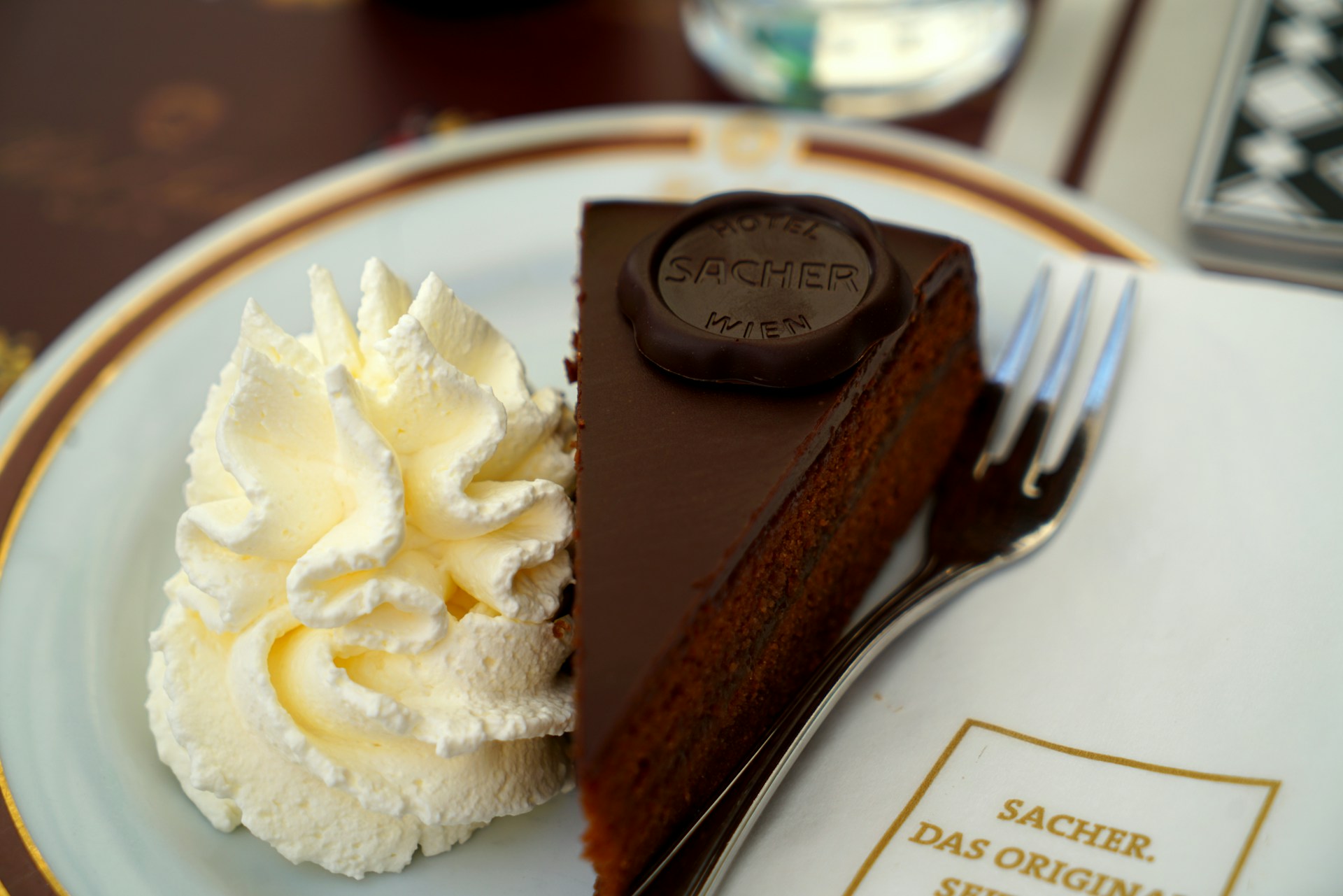
How the ritual actually works, what to order when the menu has fourteen kinds of coffee, and which of the famous cakes are worth the queue.
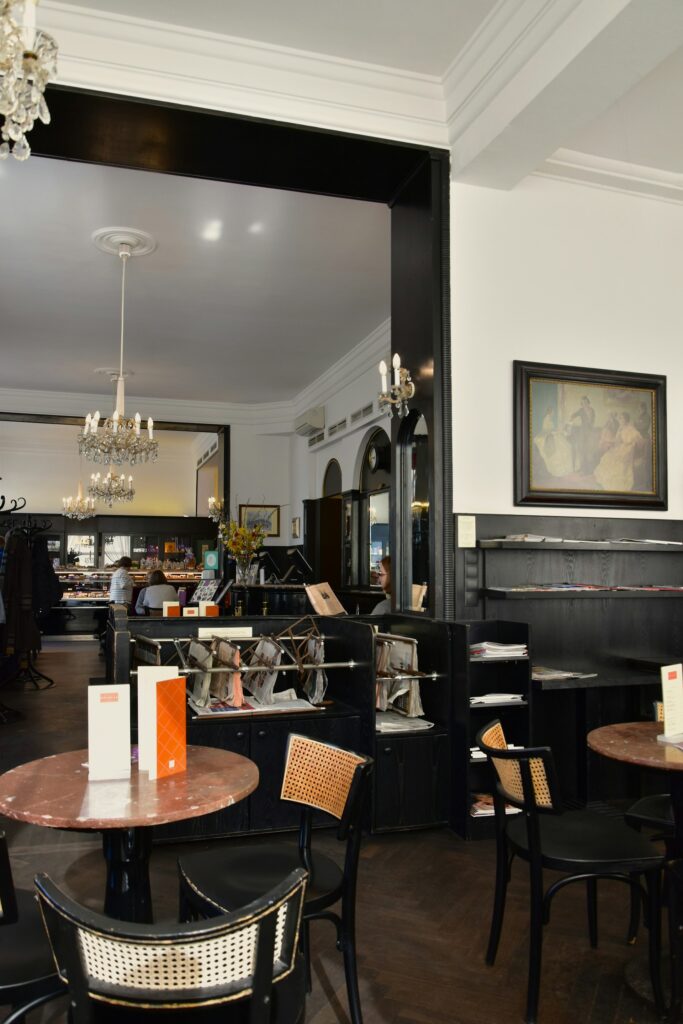
The Viennese coffee house is not quite the same thing as a café. Traditionally, one order buys you time as much as coffee: a glass of water arrives with the drink, newspapers are there to be read, and lingering is part of the culture rather than something you need to apologise for.
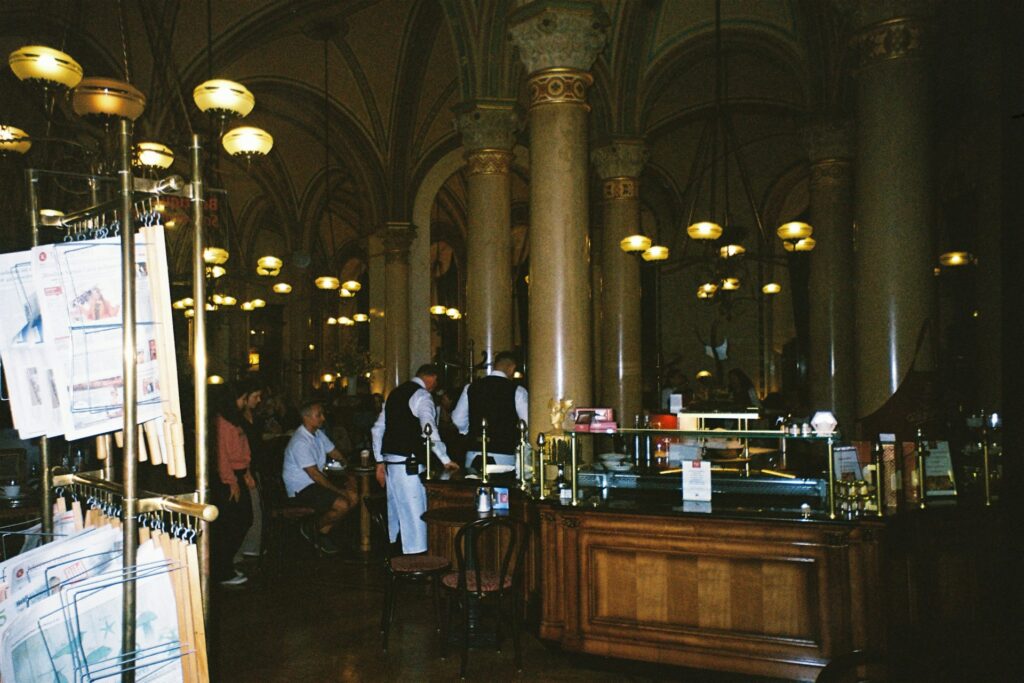
This is a real cultural form with its own conventions, and it’s the reason Vienna is one of the few cities where sitting down is itself a sight. Trotsky played chess at Café Central. Freud was a regular at Landtmann. Writers around 1900 treated the coffee house as office, salon, reading room and second home.
Most of the famous ones sit inside or just off the Ringstrasse, in the compact centre our self-guided audio tour of Vienna’s historic centre covers on foot. What follows is how to use them without feeling like you’re doing it wrong.
Quick Answer
| What you’re buying | Time as much as coffee. Lingering over one order is part of the tradition, though busy houses may work differently at peak times |
| The default order | A Melange, which is roughly a cappuccino with a Viennese accent |
| The water | Traditionally served with the coffee, usually included |
| Sachertorte | Two historically connected versions, at Hotel Sacher and Demel |
| Reliable classic | Apfelstrudel — widely available and less tied to one famous address |
| Paying | At the table, when you’re ready. Asking for the bill is normal |
| The heritage listing | On Austria’s national inventory, not the international UNESCO list |
| Café Central | Closed for renovation into late 2026; check before going |
Renovation, 2026: Café Central closed on 16 March 2026 for a full renovation in its 150th anniversary year, with reopening announced for autumn 2026. Check its current status before making the trip. While the house is closed, its pop-up Decentral has been running a few minutes away on the Freyung, in Palais Harrach.
How the Ritual Works
These aren’t formal rules. They’re the habits that make a traditional Viennese coffee house feel different from an ordinary café.
- You buy the table. Traditionally, ordering one coffee buys you time as much as a drink; lingering is part of the culture rather than a breach of etiquette.
- The water is part of the ritual. A small glass traditionally arrives with the coffee, and practices around refills vary by house. Vienna pipes its drinking water from Alpine springs and is unreasonably proud of it.
- The newspapers belong to the house. They’re on wooden racks by the door, often in several languages. Take one, put it back.
- Service is traditionally formal. In older houses it can feel more reserved and less conversational than in a modern café. Don’t mistake a brisk manner for a signal that you need to leave; the important convention is that the table is yours until you ask to pay.
- You pay at the table. Say zahlen, bitte when you’re ready. In traditional houses the bill usually comes only when you ask; bringing it unprompted can read as a signal that the table is needed back.
The Coffee Menu, Decoded
Ordering “a coffee” will get you a raised eyebrow and a follow-up question. Here’s the working vocabulary.
| Order this | You get |
|---|---|
| Melange | Coffee with hot milk and milk foam; the easiest traditional default |
| Kleiner Brauner | Small black coffee with a jug of cream on the side |
| Großer Brauner | The same, larger |
| Verlängerter | “Lengthened” — coffee extended with hot water, served black or with milk depending on the house |
| Einspänner | Strong black coffee in a glass under a thick layer of whipped cream |
| Franziskaner | Melange with whipped cream instead of foam |
| Kapuziner | Small black coffee with a little cream |
| Fiaker | Black coffee with rum or brandy, named after the horse-cab drivers |
| Mokka or Schwarzer | Plain black, no milk |
If you normally drink an Americano, a Verlängerter is the closest traditional starting point. Some houses also serve actual filter coffee separately, often listed as Hauskaffee. For something more specifically Viennese, try an Einspänner.
Which House for What
They are not interchangeable, and picking by fame alone is how people end up in a forty-minute queue for a room they don’t enjoy.
| House | Best for | Expect |
|---|---|---|
| Sacher | The cake, and the red-velvet hotel setting | Queues, tourists, and a genuinely good product |
| Demel | Pastry-watching through the glass kitchen wall | Theatrical service, crowds, imperial history |
| Sperl | The real thing: 1880 interior, billiard tables, no performance | Locals, newspapers, quiet |
| Hawelka | Postwar bohemian Vienna, dark and cramped | Buchteln in the evening, elbow room in short supply |
| Prückel | 1950s interior instead of imperial plush | A different century, and a calmer room |
| Landtmann | Politicians, actors and the Burgtheater crowd | Formality, a good terrace, higher prices |
| Bräunerhof | The classic writer’s café, famously austere | Thomas Bernhard’s old haunt, minimal charm by design |
If you only do one and want the traditional atmosphere rather than the famous photograph, Sperl is a strong choice. It has the interior, the papers and the billiard tables. Check the day first: it closes on Sundays in July and August. If you want the photograph, go to Demel or Sacher and accept the wait as part of the transaction.
Sacher Versus Demel: The Cake Lawsuit
This is the single most Viennese story in the city’s food history, and it explains why two different cakes both have a claim to the same name.
Franz Sacher invented the chocolate-and-apricot torte as a teenage apprentice in 1832. His son Eduard refined it, trained at Demel, and later founded the Hotel Sacher. Both houses ended up selling it. Both claimed the original. The dispute went through the Austrian courts for decades in the middle of the twentieth century.
The legal fight eventually left Hotel Sacher with the exclusive right to call its cake the Original Sacher-Torte. Demel sells its own historically connected version, today as Demel’s Sachertorte. Everything else in Vienna labelled Sachertorte is chocolate cake with apricot jam, which may be very good and is not the same object.
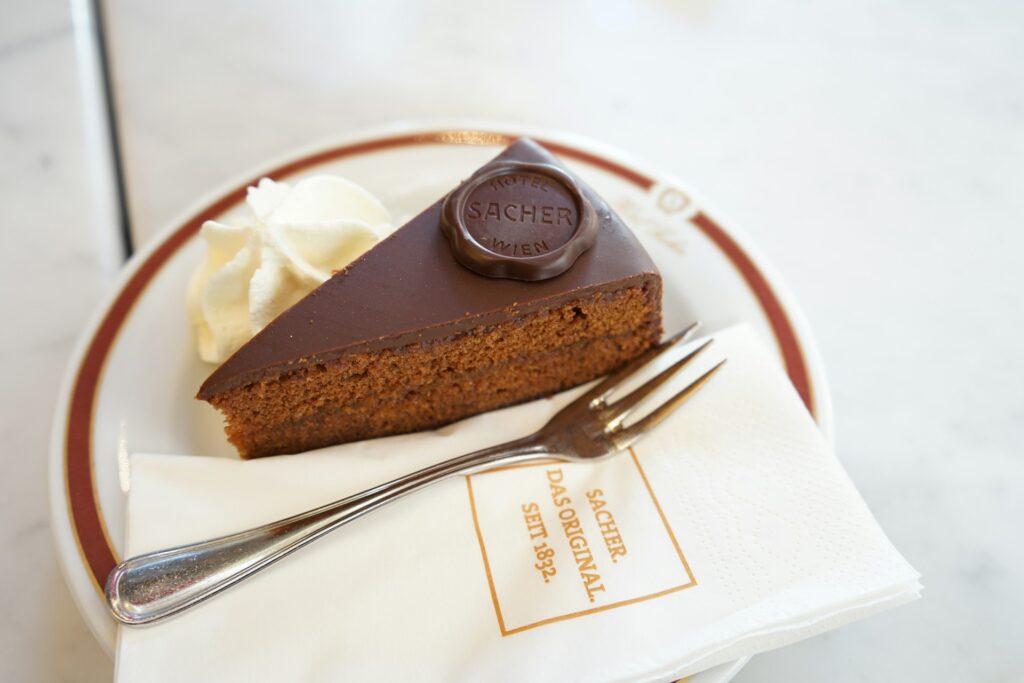
Older accounts distinguish the two by where the apricot jam sits, but that shortcut no longer works: both houses now describe their cakes as having jam between the layers as well as beneath the glaze. The useful difference for a visitor is the house, the setting and the cake in front of you rather than a neat one-layer-versus-two rule.
Café Sacher publishes its current slice price online; Demel doesn’t list a café slice price, so compare the menus rather than making price the deciding factor.
Two things nobody tells you. Compared with a modern fudge cake, Sachertorte can taste surprisingly dry and dense; Sacher traditionally serves it with unsweetened whipped cream, which changes the balance considerably. And if the Café Sacher queue is the only obstacle, the adjacent Sacher Confiserie sells Original Sacher-Torte for takeaway, so you don’t need a café table just to try the cake. Café Bel Étage opposite the Opera is the sit-down alternative.
The Desserts That Earn Their Place
Sachertorte is the famous one. It is not the best one.
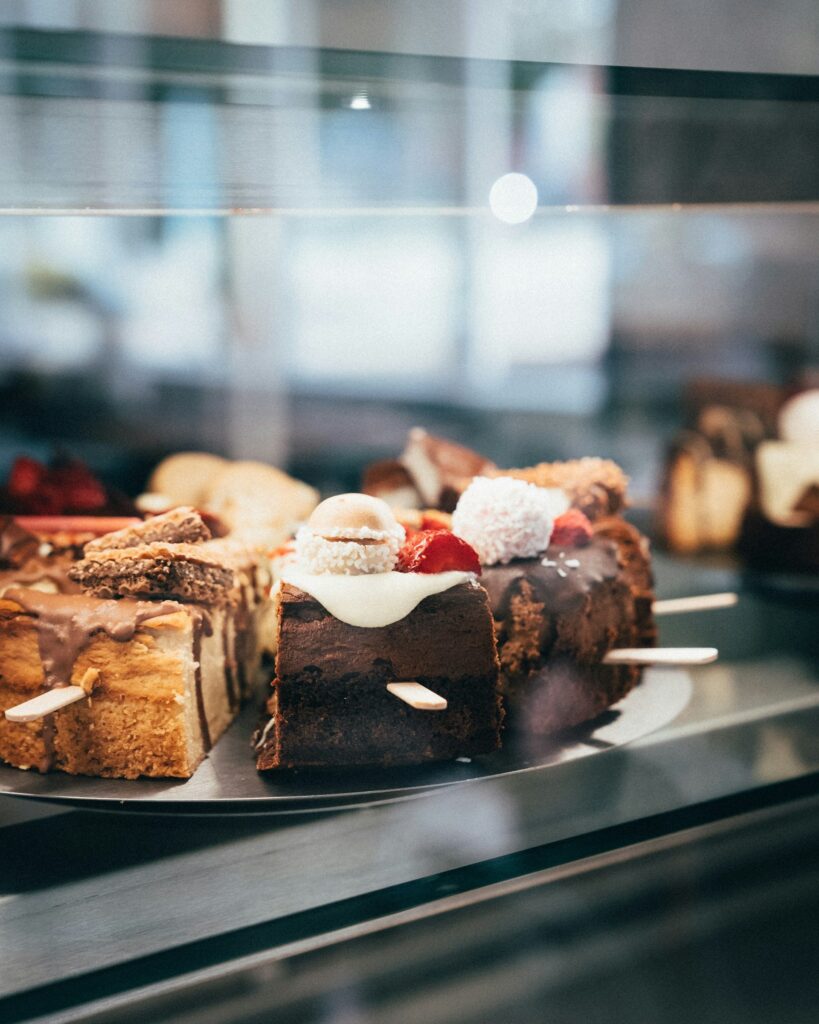
- Apfelstrudel is the reliable choice: thin pastry, apple, cinnamon, raisins, served warm with whipped cream or vanilla sauce. Available almost everywhere, hard to ruin, and much harder to turn into a tourist pilgrimage than Sachertorte. If you want to see it made, the Café Residenz in the grounds of Schönbrunn runs a strudel demonstration through the day.
- Kaiserschmarrn is shredded, caramelised pancake with plum compote, served in a portion sized for someone who has been skiing. It’s a dessert in cafés and a main course in mountain huts. Portions can be substantial, so check the size before ordering one each.
- Topfenstrudel — filled with quark rather than apple — is less internationally famous and worth trying if you want something beyond the standard Apfelstrudel.
- Punschkrapfen are pink cubes of rum-soaked cake, glazed and slightly alarming. Esterházytorte is layered almond meringue with buttercream. Guglhupf, the ring-shaped marble cake, was a favourite of Franz Joseph; legend says Katharina Schratt baked one for his breakfast every day. It’s the least fashionable and most comforting thing on any counter.
GetYourGuide
Kunsthistorisches Museum tickets
Vienna’s grandest café sits under the museum’s cupola, which means the coffee comes with a museum ticket. Booking ahead saves the queue at the entrance.
Check tickets and times →The Heritage Listing Everyone Gets Wrong
You’ll read constantly that Viennese coffee house culture is “on the UNESCO list”. That’s not quite what happened.
Austria maintains a national inventory of intangible cultural heritage under the UNESCO convention, and Viennese coffee house culture was added to that national inventory in 2011. It isn’t the same as inscription on UNESCO’s international representative list. The distinction matters mainly because the claim gets repeated as a marketing line, and because the actual designation is still a real one: a state formally recognising that sitting in a room with a newspaper is a cultural practice worth protecting.
Practicalities
The rest is mechanics — when the doors open, how the bill works, and what makes a table easy to get.
- Hours. Most traditional houses open early — 7:00 or 8:00 a.m. — and close in the evening rather than at night. A few close one day a week.
- Reservations. Many traditional coffee houses accept walk-ins. Reservations are available at Landtmann and recommended at Café Sacher if you want a guaranteed table.
- Breakfast is a real institution: soft-boiled eggs in a glass, ham, cheese, a Semmel roll, coffee. It can also be a relatively good-value way to eat in the first district, which is worth knowing if you are watching what Vienna costs.
- Payment. Card acceptance is now widespread, but carrying some cash is still useful in traditional houses. Tipping works as elsewhere in Vienna: state the total you want to pay rather than leaving money on the table.
- Dogs are common in Viennese coffee houses, though individual house rules apply.
Common Mistakes
Nearly everything that goes wrong here comes from treating a coffee house like a café: somewhere to get a drink rather than somewhere to stay.
- Ordering “a coffee”. The menu has more than a dozen preparations and the waiter will ask which one.
- Standing in the Café Sacher queue just to try the cake. The adjacent Sacher Confiserie also sells Original Sacher-Torte for takeaway.
- Assuming the most famous houses are automatically the best fit. Sperl, Prückel and Bräunerhof offer very different versions of the traditional atmosphere and are worth considering before defaulting to Sacher or Demel.
- Feeling rushed and leaving after twenty minutes. The seat is what you paid for. Use it.
- Waiting for the bill. It won’t come until you ask.
- Judging Sachertorte against a fudge cake. It’s denser and drier than many visitors expect. Eat it the traditional way, with unsweetened whipped cream.
Continue Exploring
- What to see in Vienna — the sights the coffee breaks sit between.
- One day in Vienna — where a coffee house fits into a single day.
- A walking tour of Vienna — the centre on foot, with the historic houses on the route.
- The best museums in Vienna — including the ones with a café worth the visit on its own.
- Booking ahead: Vienna experiences and food walks and the Schönbrunn strudel show.
Frequently Asked Questions
What is a Viennese coffee house?
A traditional café where lingering over a drink, reading newspapers and using the room as a social space are part of the culture. It’s a recognised cultural institution rather than a style of decor.
What coffee should you order in Vienna?
A Melange is the standard choice. For something more specifically Viennese, an Einspänner — black coffee in a glass under whipped cream.
Where is the best Sachertorte?
Hotel Sacher and Demel both sell a legitimate version, and they’re different recipes. Sacher’s is the “Original Sacher-Torte”; Demel sells its version as “Demel’s Sachertorte”.
Is Café Central open?
It closed in March 2026 for a full renovation, with reopening announced for autumn 2026 — check its current status before going. During the closure its pop-up, Decentral, has been running nearby on the Freyung.
Do you tip in Viennese coffee houses?
Yes, usually by rounding up the bill. Say the total you want to pay when handing over the money.
Is Viennese coffee house culture UNESCO-listed?
It’s on Austria’s national inventory of intangible cultural heritage, added in 2011 — not on UNESCO’s international list, though the two get conflated constantly.
Disclosure: this article contains affiliate links to TouringBee and GetYourGuide. If you book through them we may earn a commission, at no extra cost to you.