
No products in the cart.

Empress Sisi: The True Story
Who Elisabeth of Austria actually was, what the films get wrong, and where to find her in Vienna today.
Who Elisabeth actually was, what the films get wrong, and where to find her in Vienna today.
Vienna sells Sisi harder than it sells any other historical figure. Her face is on chocolate boxes, tote bags and the side of tour buses, usually the same portrait: twenty-eight years old, diamond stars in her hair, looking gently past the viewer. It’s a good likeness of a woman who later severely restricted new portraits and often hid her face in public.
The real Elisabeth of Austria is a harder and more interesting story than the merchandise suggests. She was married at sixteen into one of Europe’s most rigid courts, and she spent forty-four years working out how to be absent from it. She was intelligent, athletic, deeply unhappy, intensely controlling about her appearance and weight, and — by the end of her life — far more complicated than the decorative image Vienna still sells. She could also inspire real public affection, particularly in Hungary, despite spending much of her later life avoiding the ceremonial role expected of her.
She’s also unavoidable if you’re visiting the Hofburg, which is where the museum built around her sits, and where our self-guided audio tour of Vienna’s historic centre passes on its way through the old city. This article is the background that makes the museum land differently.
Quick Answer
| Who she was | Elisabeth of Austria, 1837–1898, Empress of Austria and Queen of Hungary |
| Why she matters | One of the best-known Habsburg figures today, and the one whose modern image remains most contested |
| Where to see her in Vienna | The Sisi Museum and Imperial Apartments at the Hofburg |
| Also | Schönbrunn, the Imperial Crypt, the Hermesvilla, the Vienna Furniture Museum |
| The screen versions | Very different interpretations; none should be treated as documentary history |
| How she died | Assassinated in Geneva in 1898 by an Italian anarchist |
| Time needed | 60–90 minutes at the Hofburg for the museum and apartments |
Temporary closure: from 6 October to 18 November 2026 the museum section of the Sisi Museum is closed for renovation. The Imperial Apartments stay open 10:00–16:30, and the standard ticket is reduced by 25 per cent; the discount doesn’t apply to the Sisi Pass.
He Was Expected to Marry Her Sister
In 1853 the twenty-three-year-old Emperor Franz Joseph travelled to Bad Ischl to meet his cousin Helene, known in the family as Néné, as a prospective bride. His mother, Archduchess Sophie, who was Helene’s aunt, strongly favoured the match.
Helene’s fifteen-year-old sister Elisabeth came along. Franz Joseph noticed her instead, and within days the engagement was announced — his own choice rather than the match his mother had expected.
It reads as romantic and it was, briefly. It was also the beginning of the problem. Elisabeth had been raised in Bavaria in a household that was aristocratic but famously informal: her father took her riding, tutors came and went, nobody enforced very much. She was married in Vienna in April 1854, four months past her sixteenth birthday, into a court that ran on Spanish ceremonial protocol dating back centuries and that had an opinion about which hand she used to hold a fan.
The Golden Cage
The metaphor fits.
Her mother-in-law, Archduchess Sophie, ran the imperial household and considered the new empress a badly educated child in need of correction. When Elisabeth’s first children were born, Sophie took charge of them: the nursery was near her own apartments, and the mother’s access was scheduled. Elisabeth’s eldest daughter died at the age of two while travelling with her parents in Hungary — a loss that became one of the defining traumas of her early marriage and deepened the conflict over her role as a mother.
Her husband, meanwhile, worked. Franz Joseph rose before dawn, ruled by memorandum, and treated the empire as a filing problem that could be solved with sufficient diligence. His surviving letters make his attachment to her clear, but the marriage increasingly operated at a distance, and government consumed his days.
What Elisabeth had instead was ceremony. Fittings, receptions, appearances, and a court that watched everything she did and reported on it. She was extremely good at the public part when she chose to be — her charm was a real political asset, and her sympathy for Hungary contributed to the compromise that made the empire dual in 1867. She simply refused to do it as a full-time occupation.
The Discipline
This is the part the postcards flatten into “she was beautiful”.
Elisabeth turned her appearance into a regimen and then into a prison. Her hair reached below her knees and took hours to dress each day; a personal hairdresser travelled with her, and the empress read and studied Greek during the sessions because they were otherwise unbearable. She exercised constantly — gymnastic rings and bars were installed in her private rooms, which was close to unthinkable for a woman of her rank — and became an exceptional horsewoman.
She also ate very little and controlled her weight with an obsessiveness her own household found alarming. She became increasingly selective about portraits and photographs: the last known likeness for which she sat personally dates from 1879, when she was forty-one, and later public images usually reused, retouched or recombined earlier portraits. The image the city sells is therefore permanently young.
Her eating habits, constant weighing and extreme control of her body have led modern biographers to discuss her behaviour in terms that go well beyond simple vanity. Whatever label is applied retrospectively, the regimen was severe enough to alarm the people around her.
Escape
From her thirties onward, Elisabeth solved the court by leaving it.
She travelled almost continuously — Hungary, Corfu, Madeira, England, Ireland, the Mediterranean, sometimes under an assumed name, often for months. She built a villa on Corfu, then lost interest in it. She hunted in England and Ireland with a recklessness that alarmed her hosts. She wrote a great deal of poetry, most of it bitter, and had it sealed for decades after her death.
The travel is often described as restlessness, but it also functioned as a working arrangement: she was absent, the court functioned without her, and her husband — who by then had a long, semi-public attachment to the actress Katharina Schratt, one that Elisabeth herself had helped along — got on with governing.
What Broke Her
Two deaths, thirty years apart.
The first was her eldest daughter, Sophie, in 1857. The second was her only son.
Crown Prince Rudolf was found dead at the hunting lodge at Mayerling in January 1889, along with his young mistress. The court’s first statements were false, then partially corrected, and the family suppressed what it could. Rudolf had been politically at odds with his father for years, and his death was dynastic as well as personal. With the direct male line broken, the succession eventually shifted to Franz Joseph’s nephew Franz Ferdinand, whose assassination in Sarajevo in 1914 helped trigger the First World War. The monarchy collapsed four years later.
Elisabeth wore black for the rest of her life. She had already been withdrawing. After Mayerling she withdrew even further from public life and appeared increasingly rarely in her ceremonial role.
Geneva, 1898
On 10 September 1898, walking to a steamer on the lakefront in Geneva with a single lady-in-waiting and no guards, Elisabeth was stabbed by an Italian anarchist named Luigi Lucheni. He had come to Geneva intending to kill a different royal, who had changed his plans; a newspaper had printed the empress’s presence in the city.
The wound was so narrow that she got up and walked onto the boat. She died a short time later, at sixty.
The detail most often repeated belongs to her husband. Told the news, Franz Joseph is reported to have said that no one would ever know how much he had loved her — a line that carries much of the tragedy of their marriage in it.
Where to Find Her in Vienna
| Place | What’s there | Notes |
|---|---|---|
| Sisi Museum, Hofburg | The dedicated museum: personal objects, reconstructions, the mythology examined | The main visit |
| Imperial Apartments, Hofburg | Her and Franz Joseph’s private rooms | Same ticket |
| Imperial Crypt | Her tomb, beside Franz Joseph and Rudolf | Separate €15 admission |
| Schönbrunn | Her rooms in the summer residence | Part of the palace routes |
| Hermesvilla, Lainzer Tiergarten | The villa Franz Joseph built to keep her in Vienna | Seasonal, see below |
| Vienna Furniture Museum | Court furnishings and a permanent display about the Sissi films, including furniture used on the sets | Included in the Sisi Pass |
-
The Sisi Museum is the one to do, and our Hofburg guide covers its ticketing, which is more complicated than it looks. What’s worth knowing in advance is that the museum is not a shrine. It was designed around the gap between the marketed Sisi and the documented one, and a good part of it is about how the myth was built.
-
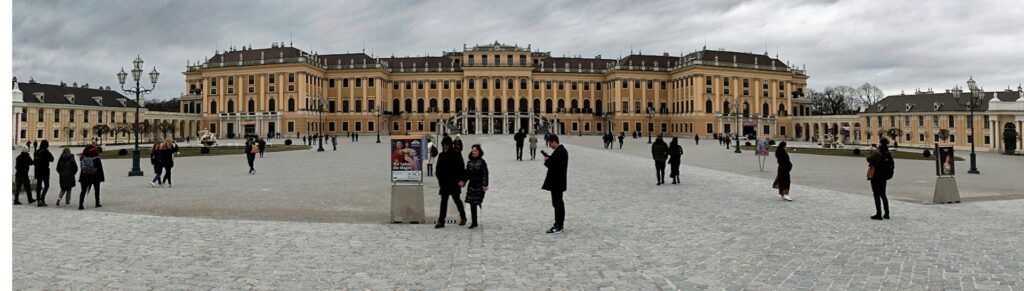
Schönbrunn is the other imperial address with rooms of hers on the route; the palace guide explains the ticket types, and timed Schönbrunn tickets are worth sorting out before you go on a busy afternoon.
-
The Hermesvilla is the outlier. Franz Joseph had it built in the 1880s inside the imperial hunting grounds at Lainz, hoping a private retreat would keep Elisabeth in Vienna more often. She called it her castle of dreams and, from 1887, returned regularly in May and usually stayed into late June.
The interiors also connect the villa to late-nineteenth-century artistic Vienna: Hans Makart designed the decorative scheme for her bedroom, while Franz Matsch and the brothers Georg and Gustav Klimt contributed elsewhere in the private apartments. The bedroom’s A Midsummer Night’s Dream paintings were executed by Rudolf Carl Huber.
Check the season before going, because this is the one that ruins trips. The villa opens for part of the year only, on a limited set of days each week — in 2026 that means Friday to Sunday from early May until the end of September. It also sits inside a nature reserve where cars and bicycles aren’t allowed: the approach is the U4 to Hietzing, bus 56B to Lainzer Tor, then a walk through the woods. Treat it as a half-day excursion rather than an add-on to the Hofburg.
GetYourGuide
Imperial palace tickets in Vienna
The Hofburg, Schönbrunn and the Imperial Crypt are all ticketed separately, and the palace routes fill up on wet afternoons. Comparing timed slots before you arrive is the difference between walking in and queueing.
See Vienna tickets →The Films, and What They Get Wrong
Three separate Sisis are in circulation, and visitors usually arrive carrying one of them.
- The Romy Schneider trilogy (1955–57) is the one that built the industry. It is warm, gorgeous and almost entirely a fairy tale: it ends before anything difficult happens, and its version of the marriage bears little relation to the letters. Schneider spent much of her later career trying to escape it.
- Corsage (2022, with Vicky Krieps) goes the other way — a deliberately anachronistic portrait of the empress at forty, chafing, self-harming, funny and furious. It invents freely and says so, but it draws on documented elements the 1950s films largely avoid: her hostility to court ritual, the severity of her body discipline, the constant travel, ageing and withdrawal from public life.
- The Empress (Netflix, 2022) is a costume drama that takes real events and shapes them for serial television.
The useful frame is simple. The Romy Schneider films created the fairy-tale Sisi, Corsage deliberately dismantles it, and the museum at the Hofburg is where you can compare either version against documents and objects from her life.
Common Mistakes
The distance between the Elisabeth on the souvenirs and the one in the documents is where most of the disappointment lives.
- Expecting the Sisi Museum to confirm the films. It’s designed to complicate the fairy-tale image, not reinforce it.
- Going to the Hermesvilla without checking the season. It’s open on limited days for part of the year only, and it’s a genuine trip.
- Treating her as a purely tragic figure. She was also formidable: a serious horsewoman, a competent linguist, and politically effective when she chose to engage.
- Assuming the diamond stars on display belonged to her. The famous hair jewels have been widely reproduced, and the status of individual pieces varies. Check the museum labels rather than assuming every star is an original of hers.
- Skipping the Imperial Crypt. It’s ten minutes away and separately ticketed, and it places Elisabeth, Franz Joseph and Rudolf together in one room in a way no exhibition can reproduce.
Continue Exploring
- The Hofburg: tickets, routes and what’s actually inside — the palace complex that holds the Sisi Museum.
- Schönbrunn Palace guide — her summer rooms and the rest of the estate.
- Best museums in Vienna — where the Sisi Museum sits among the city’s bigger collections.
- Walking tour of Vienna — the route that links the Hofburg with the rest of the old city.
If you’d rather book the big-ticket sights before you land, Vienna tickets and tours and the Kunsthistorisches Museum, which holds the Habsburg collections themselves, are the two worth sorting out in advance.
Frequently Asked Questions
Who was Empress Sisi?
Elisabeth, born Duchess Elisabeth in Bavaria (1837–1898), married Emperor Franz Joseph I at sixteen and became Empress of Austria and Queen of Hungary. She remains one of the best-known Habsburg figures and the subject of a particularly persistent modern mythology.
Where can you see Sisi in Vienna?
The Sisi Museum and Imperial Apartments at the Hofburg are the main places to start. Her tomb is in the Imperial Crypt, her rooms are at Schönbrunn, and the Hermesvilla in the Lainzer Tiergarten opens seasonally.
How did Sisi die?
She was assassinated in Geneva on 10 September 1898 by an Italian anarchist, at the age of sixty.
Is the Sisi Museum worth visiting?
Yes, particularly if you’ve seen any of the films. It’s designed around the difference between the marketed image and the documented life.
Was the marriage happy?
It began as a love match and became increasingly distant. Franz Joseph’s attachment to Elisabeth is well documented, while she spent more and more of her life away from court, and eventually away from Vienna itself.
Is Corsage accurate?
Not as biography: it invents scenes and uses deliberate anachronism. But it draws on documented aspects of Elisabeth’s middle age that the 1950s films largely avoid, including her hostility to court ritual, severe body discipline, constant travel and withdrawal from public life.
Disclosure: this article links to TouringBee’s own audio guide and to GetYourGuide. If you book through those links we may earn a commission, at no extra cost to you.