
No products in the cart.

What to See in Vienna: The Sights That Are Worth Your Time
Palaces, museums, coffee houses and an honest answer to the real question: what actually fits into a first trip to Vienna, and what you can leave for next time.
Palaces, museums, coffee, and an honest answer to the real question: what fits, and what you can leave for next time without guilt.
Vienna lost an empire but had the foresight to keep all the furniture: palaces, crowns, an opera house, several centuries of collected paintings, and coffee houses where a single cup buys you enough time that the waiter starts treating you as part of the décor.
Vienna’s trap is its facades. They’re handsome, they’re important, and they are completely tight-lipped about who lived behind them, what happened on that corner, and why there’s a tree stump full of nails bolted to a wall on a busy street. Without context, the city blurs by evening into one long beige palace — which is why we built a self-guided audio tour of the historic centre: 29 stops, about two and a half hours, and the pace is yours.
Most first visits run two or three days, and the wish list runs closer to a week — cathedral, Hofburg, Schönbrunn, Belvedere, the opera, the museums, and ideally a moment to work out the difference between a Melange and a Kapuziner. The good news is that almost everything downtown sits close together. The bad news is that this is exactly why you’ll want to go everywhere.
Vienna at a Glance
| Question | Answer |
|---|---|
| How many days | 1 day for the centre; 2–3 if you add the palaces |
| Walk or ride | Walk downtown; take the metro or tram to Schönbrunn, Belvedere and the outer districts |
| Where to start | St. Stephen’s Cathedral (Stephansdom) |
| Which museum matters most | Belvedere for Klimt; the Kunsthistorisches for old masters |
| Is it expensive | Yes, cafés and restaurants especially — noticeably pricier than Prague or Budapest |
| Closed on Sundays | Most shops. Exceptions: train stations, the airport, museum shops |
| City cards | Vienna City Card covers transit and discounts (€19 for 24 hours to €39 for seven days); Vienna PASS covers admission to around 90 sights and starts at €109 for one day |
How Central Vienna Is Laid Out
Vienna’s geography looks imperially complicated at first. The tourist version of the city fits into one simple diagram.
The historic core is the 1st district, the Innere Stadt, ringed by the Ringstrasse — a wide boulevard built on the ground where the city walls used to stand. Nearly every must-do on a first visit sits within that ring. Districts 2 through 9 wrap around it from different sides, though the number itself is not a distance scale: parts of a high-numbered district can sit closer in than parts of a low-numbered one. When you’re choosing where to stay, the specific address and the nearest metro stop tell you more than the number does.
The rule that saves you time: walk inside the Ring, ride outside it. Getting around on public transport is straightforward once you know that the metro has no ticket barriers and that the tickets still get checked.
Schönbrunn and Belvedere both sit beyond the core, and both need a deliberate trip. Neither one accepts the “we’ll just pop in for five minutes” approach.
St. Stephen’s Cathedral: Where Everyone Starts
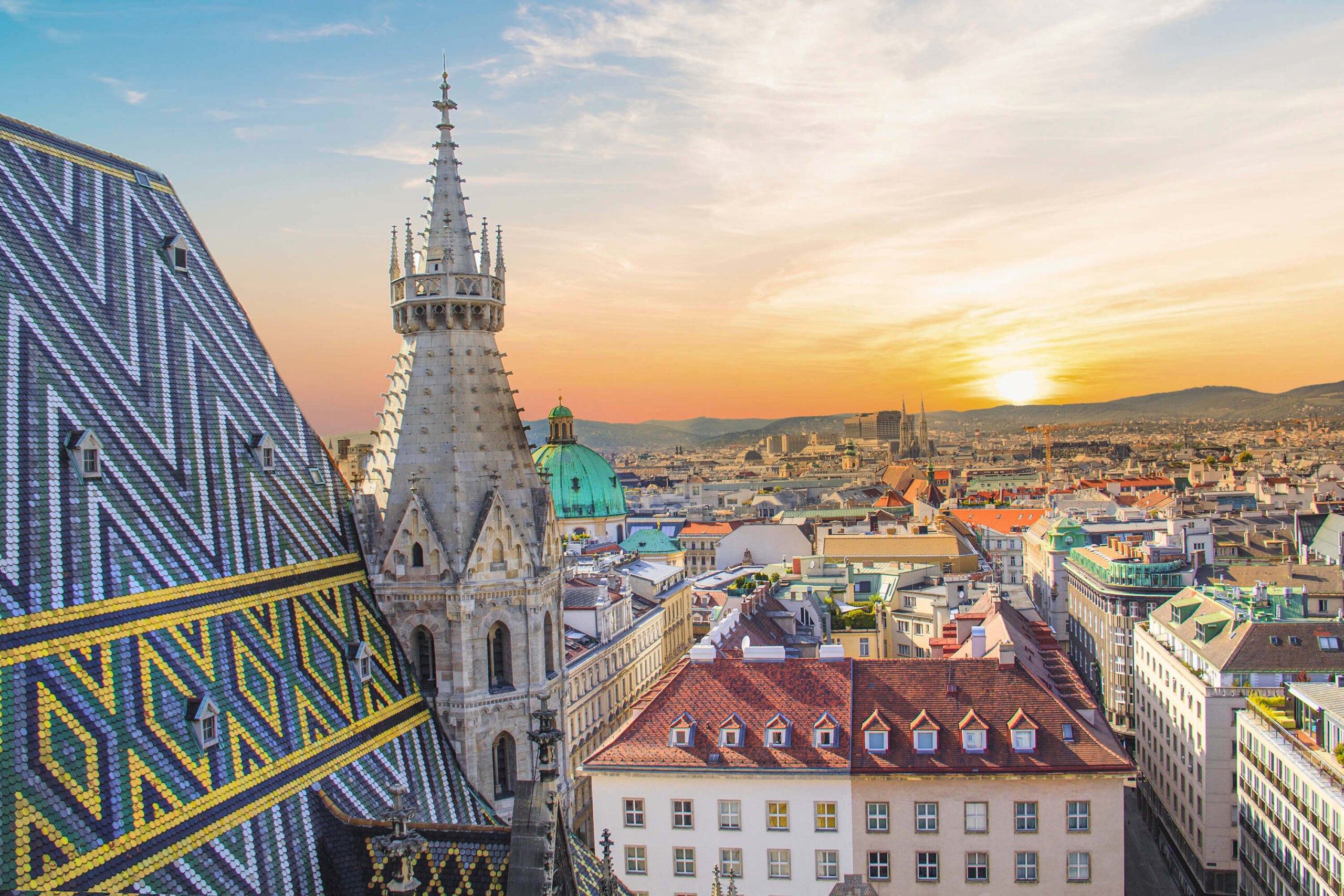
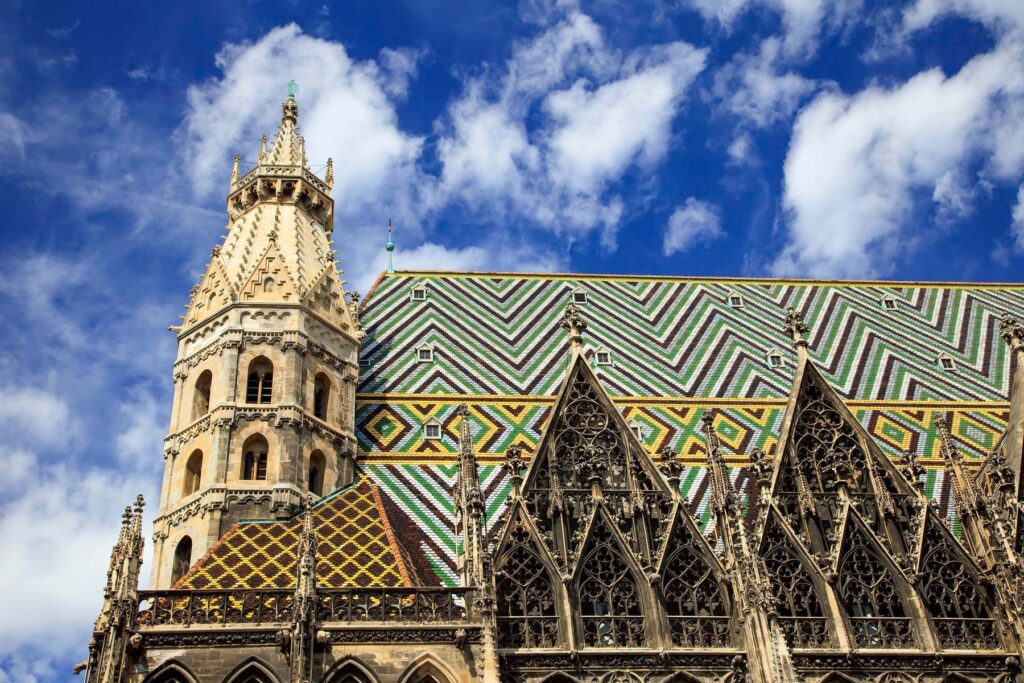
Stephansdom is Vienna’s best zero point. Distances get measured from here, walks start here, and it is where you meet the friend who got lost one street over. Roughly 850 years old, the cathedral looks like an architectural layer cake — each era built onto the last.
Your first decision is the tower. The south tower, the Steffl, was finished in 1433: 343 steps, no lift, and the more open view. The unfinished north tower has a lift and holds the Pummerin, Austria’s largest bell. Choose the south for the view and the north for the easier climb; in August, 343 Gothic steps can feel more like cardio than sightseeing.
The catacombs are a short guided visit through plague burials and part of the Habsburg funerary tradition — traces of the epidemic that reshaped the medieval city, alongside imperial remains.
Before going inside, walk around the exterior. Medieval units of measurement are set into the stone, a carved sundial survives on the choir, and nearby is the figure nicknamed Christ with a Toothache. Almost none of it is labelled, and every one of those details has a story attached that the building itself will not tell you.
The Hofburg: A City Inside the City
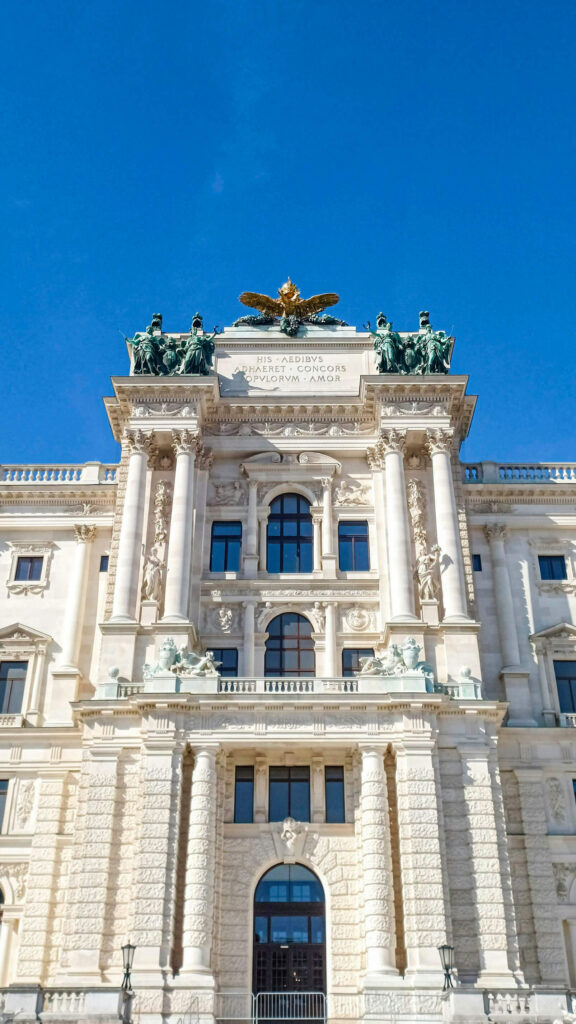
The Hofburg isn’t one palace. It’s a district that seven centuries expanded on the principle of “we need more rooms again.” The result runs to around 2,600 rooms, several courtyards, a chapel, museums, a library, the Spanish Riding School, and the office of the Austrian president.
There’s no single “admission to the Hofburg” ticket. Inside are independent museums and institutions, each with its own entrance, hours and box office — so you’re choosing regardless, and it goes better if you choose in advance.
Imperial Apartments and Sisi Museum — €20, timed entry. Franz Joseph’s living quarters, and the real story of Empress Elisabeth without the sugar coating.
Imperial Treasury — €16 online, €18 at the door. The crowns and regalia of the Holy Roman Empire.
State Hall of the National Library (Prunksaal) — €12. A baroque hall about 80 metres (260 feet) long holding over 200,000 books; open daily 9:00 a.m. to 6:00 p.m. in summer, Thursdays until 9:00 p.m.
Spanish Riding School — the Lipizzaner horses. Morning training is easier to get into than a performance. Both run on a season: in 2026 morning training resumed on 4 August and performances on 15 August, so early-August visitors may find neither.
With two hours, the sensible pairing is the Imperial Apartments plus the State Hall. The library takes less time than you’d expect, and the payoff from the dome, the frescoes and the book galleries is out of all proportion to the fifteen minutes it costs you.
Schönbrunn and Belvedere: The Two Palaces Outside the Centre
Both are a short metro or tram ride from the centre, and both need half a day if you do them properly. If your trip is short, this is the choice that shapes it.
Schönbrunn Palace was the Habsburg summer residence and is the fuller palace experience. Choose it for imperial rooms and a park that can take as much time as the interior; the walk to the Gloriette and the hilltop view are free. Timed-entry slots are the constraint here rather than the queue, so it is worth checking what’s available at Schönbrunn before you commit the morning to it.
Belvedere was built for Prince Eugene of Savoy and is the stronger choice for art. Klimt’s The Kiss hangs in the Upper Belvedere, alongside a major collection of his work and paintings by Egon Schiele. The garden between the Upper and Lower Belvedere is free.
Neither is the only palace in Vienna — there are several more that most visitors never open the door of — but these are the two that matter most on a first trip.
Graben, Kohlmarkt, Michaelerplatz: The Streets Themselves
These three connect the cathedral to the Hofburg, and walking them is the closest Vienna comes to a set piece.
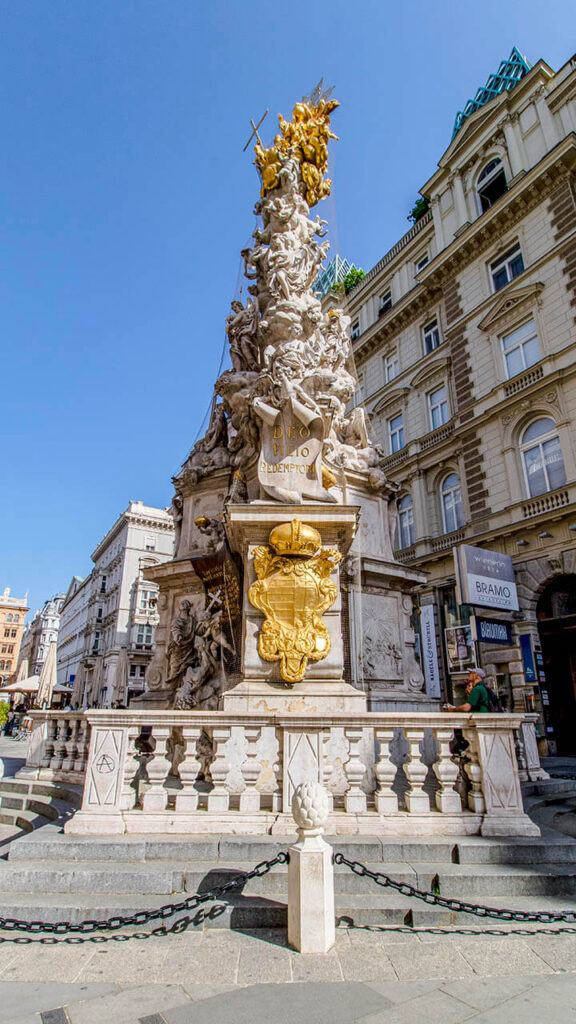
The Graben is a wide pedestrian street with a plague column in the middle of it, commissioned by Emperor Leopold I after the epidemic of 1679 killed roughly a third of the city. It is high baroque and completely over the top, which is the point. Just off it, St. Peter’s Church is small, oval, and one of the most concentrated baroque interiors in the city — free to enter, open 8:00 a.m. to 7:00 p.m. on weekdays and from 9:00 a.m. at weekends.
Kohlmarkt runs from the Graben toward the palace and is where Vienna keeps its expensive shops and its best-known confectioner. At the end, Michaelerplatz opens out in front of the Hofburg’s domed gate. Look down in the middle of the square: there is an excavated Roman layer visible below street level, left from the garrison town that stood here before Vienna did.

The Ringstrasse: Opera, Parliament, City Hall, University
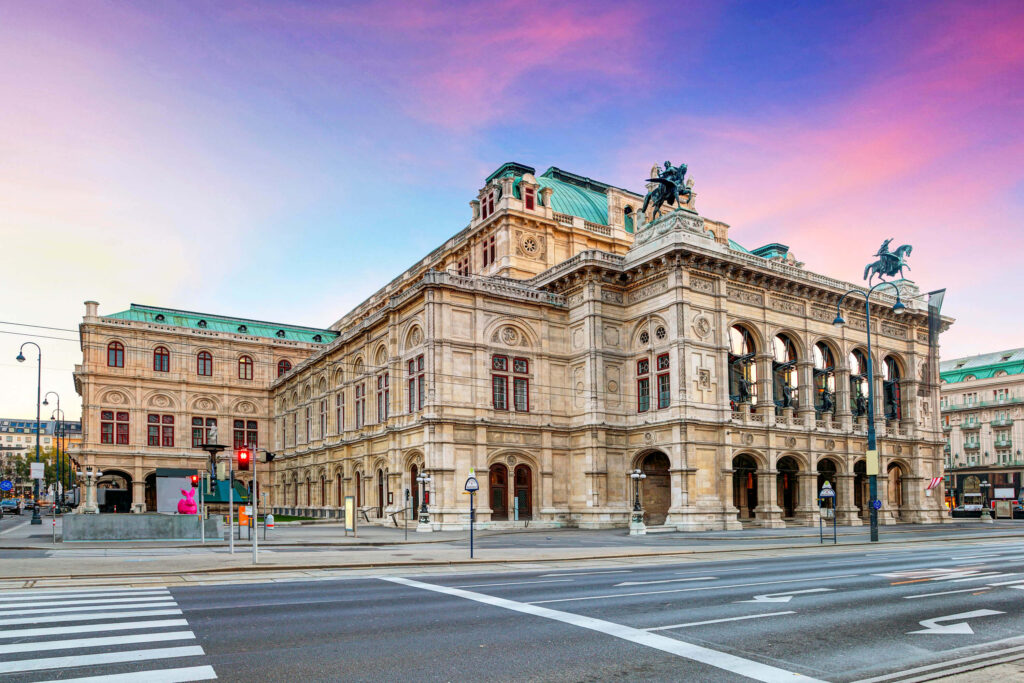
When the city walls came down in 1857, the space became the Ringstrasse: a boulevard lined with public buildings designed in whichever historical style seemed to suit their purpose. City Hall got Gothic, Parliament got Greek, the University got Renaissance, and the State Opera received a grand neo-Renaissance facade. Critics at the time thought the result was absurd; today it forms part of Vienna’s UNESCO-listed historic centre and remains the clearest single lesson in Viennese architecture available on foot.
The State Opera is the most useful stop if you want to go inside. Same-day standing tickets can make a performance surprisingly affordable, though there is no regular repertory season in July and August. City Hall offers free guided tours on selected weekdays, while the square outside changes with the season — a Christmas market in winter and an open-air film festival in summer.
You do not have to walk the entire Ring. Trams 1 and 2 cover different sections past the Opera, the Hofburg, Parliament, and City Hall. They are regular public transport rather than sightseeing trams, so check the current route in WienMobil before boarding.
Museums Worth a Dedicated Day
Vienna has too many museums for a short trip, so the honest advice is to choose two and skip the rest without guilt.
| Museum | Best for | Admission | Hours |
|---|---|---|---|
| Kunsthistorisches Museum | Bruegel, Vermeer, the cabinet of curiosities | €22 online, €24 at the door | Daily 10:00–18:00, Thu until 21:00 |
| Albertina | Dürer to Monet, plus the state rooms | €20.90 | Daily 10:00–18:00, Wed & Fri until 21:00 |
| Leopold Museum | Egon Schiele and Viennese modernism | €19 | Daily 10:00–18:00 |
| Upper Belvedere | Klimt, Schiele, Kokoschka | €23 | See above |
The Albertina’s terrace has one of the better views of the opera house. Access can depend on what’s running there — the terrace also hosts separately ticketed events — so check before counting on it.
Beyond these four, Vienna keeps a set of small and strange museums — funeral culture, globes, clocks — which are far better than they sound and almost empty.
GetYourGuide
Palace and museum tickets, booked before you go
Schönbrunn, the Upper Belvedere and the Kunsthistorisches all run on timed entry, and the good slots regularly go before the day itself. Booking ahead is the difference between walking straight in and rearranging your afternoon around a sold-out morning.
See Vienna tickets →Coffee Houses Are a Sight, Not a Break
It’s easy to treat the coffee houses as somewhere to rest between museums. In Vienna they are the attraction. The tradition has been on Austria’s national inventory of intangible cultural heritage since 2011, and the etiquette is real: you order a specific kind of coffee rather than “a coffee,” it arrives with a glass of water on a small silver tray, and nobody will rush you out of your seat for the next three hours.
Demel opens daily 10:00 a.m. to 7:00 p.m. and doesn’t take reservations. Café Sacher runs 7:00 a.m. to 11:00 p.m. and recommends booking; a Melange is €7.50 and a slice of the Original Sacher-Torte €10.90. Café Sperl opens 7:00 a.m. to 10:00 p.m. Monday through Saturday, from 10:00 a.m. on Sundays.
The Things That Aren’t on the Postcards
Vienna hides a lot at eye level. There are courtyards behind unmarked doors in the medieval lanes, with wooden galleries running around the upper floors. There is a house with a basilisk over the entrance and a legend attached to it. There is a section of ancient tree trunk, studded with hundreds of nails, mounted behind glass on a street corner that thousands of people walk past every day without looking up.
Some of these take thirty seconds to see and are two streets from the cathedral. They just require knowing they are there — and knowing the story, because none of them comes with a plaque.
What Actually Fits Into One Day
If you have a single day, the realistic version is: the cathedral in the morning, the streets between it and the palace, two hours inside the Hofburg, lunch somewhere that does not take ninety minutes, and the opera or the Albertina in the late afternoon. That is a full day and it does not include Schönbrunn or Belvedere.
If you try to add either palace, something in the centre gets dropped. That is a fair trade if Klimt or the imperial summer residence is the reason you came — just make the choice deliberately rather than discovering at four in the afternoon that you have run out of daylight.
With a second day, Schönbrunn fits comfortably with the zoo or the park. With a third, Belvedere and the MuseumsQuartier, and an evening at a wine tavern on the edge of the city.
Seeing the Centre on Foot
Almost everything above sits within a twenty-minute walk of the cathedral, which makes Vienna one of the few European capitals where a walking route genuinely covers the highlights rather than a selection of them.
The difficulty is that the centre does not explain itself. The buildings are handsome and completely silent about who lived in them, what happened on that corner, and why a particular street is called what it is called. Guided group tours solve this but move at their own pace, which is the argument for walking the centre with the commentary in your ear instead — stop for coffee, double back, finish tomorrow.
First-Time Practicalities, Briefly
Sundays: most shops close. Major museums and many cafés and restaurants stay open, though it’s worth checking the specific venue.
Transport: the metro has no ticket barriers. This is not an invitation — inspectors are frequent and the fine runs €135 paid on the spot, €145 later.
Water: Vienna’s tap water comes from Alpine springs. Drink only from dedicated public drinking fountains, not from decorative ones.
Booking: the popular restaurants, Schönbrunn, the Upper Belvedere and the Spanish Riding School need reserving. Most museums do not, outside peak season.
Frequently Asked Questions
How many days do you need in Vienna?
One full day covers the historic centre — cathedral, the streets to the Hofburg, two hours inside the palace complex, and one museum or the opera. Two to three days lets you add Schönbrunn and Belvedere without cutting anything from the centre.
What is the one thing you should not miss in Vienna?
St. Stephen’s Cathedral, because everything else in the centre is measured from it. If you mean the one ticket worth buying, that depends on you: the Upper Belvedere for Klimt’s The Kiss, or Schönbrunn for the imperial summer residence.
Is the Vienna PASS worth it?
Only if you plan a heavy museum schedule. It starts at €109 for one day and covers admission to around 90 sights, so it pays off at roughly four or five paid attractions in a day. The Vienna City Card (€19 for 24 hours) is a transport-and-discounts card and a different proposition entirely.
Can you see Vienna on foot?
Inside the Ringstrasse, yes — almost everything sits within a twenty-minute walk of the cathedral. Schönbrunn and Belvedere are the exceptions and need the metro or a tram.
Is Vienna expensive?
Compared with Prague or Budapest, noticeably so, and cafés and restaurants are where you feel it most. Museum admission is broadly in line with other Western European capitals.
Continue Exploring
- Self-guided city walking tours that actually work
- Museum audio guides: are they worth it?
- How to find a self-guided tour near me
- Belvedere Palace tickets — Klimt, Schiele and Kokoschka in the Upper Belvedere
- Kunsthistorisches Museum tickets — Bruegel, Vermeer and the cabinet of curiosities
- Schönbrunn Palace Garden and Gloriette — the park, the hill and the view back over the city
Disclosure: this article contains links to our own TouringBee audio guides and affiliate links to GetYourGuide. If you buy through them, we may earn a commission at no extra cost to you. It never affects what we recommend.