
No products in the cart.

Christmas Traditions in France: History, Customs and Legends
From Saint Nicholas and Père Fouettard to the bûche de Noël and Provençal santons: the history, customs and legends of a French Christmas.
A French Christmas has its own characters, its own dates, and a very long dinner. Many of its customs began in the regions of France and only later took root in Paris. It’s a story of saints and their sinister companions, glassblowers and pastry chefs, and it isn’t always easy to tell where history ends and legend begins.
Christmas at the table
Christmas in France revolves around the family table. The holiday dinner can last for hours, with several generations gathered around it, swapping family stories.
Paris has Christmas stories of its own. One of the strangest happened more than a century and a half ago, during the Siege of Paris in 1870. Even the Christmas menu reflected the extraordinary food shortage, and one Paris restaurant served dishes that would have been unthinkable on a typical Christmas menu. You can hear that story in the TouringBee Marais Quarter Historical Food Tour: it’s best heard outside an old butcher shop in the Marais, where roast chickens slowly turn on a rotisserie in the shop window.
Advent: waiting for the holiday
In the church calendar, preparation for Christmas begins with Advent, the season leading up to the holiday, marked by four Sundays. In 2026, the first one falls on November 29. Children open the windows of an Advent calendar from December 1 to 24, and some families set a wreath with four candles on the table, lighting one more each Sunday. From those first candles to the galette des rois in January, a whole season of family customs unfolds.
From Saint Nicholas to Père Noël
Saint Nicholas and his dark companion
In Alsace and Lorraine, the Christmas season has another major holiday: Saint Nicholas Day, December 6. On the night before, according to old tradition, Saint Nicholas visits homes to see whether the children have been well-behaved. This bishop from Asia Minor became the best-loved saint of northeastern France, Belgium, and Luxembourg. In Lorraine his day is one of the biggest children’s holidays of the year: kids leave a carrot for his donkey, and well-behaved children wake up to find sweets and oranges, once a rare and expensive fruit.
He travels with Père Fouettard, a grim figure dressed in black who carries a switch. According to the legend, Père Fouettard tells Saint Nicholas which children have misbehaved. Well-behaved children receive gifts from the saint, while those who have been naughty can expect punishment from his companion. In Christmas stories, Père Fouettard has faded into the background over time, but in the Saint Nicholas processions of Lorraine he still walks beside the saint.
Shoes by the fireplace
American kids hang stockings; French children set their shoes by the fireplace or under the tree. Once these were peasant wooden clogs, sabots. Saint Nicholas was famous for his secret gifts, and the legend says he dropped coins right into people’s shoes. Wooden clogs are no longer everyday footwear, but in December the windows of Parisian chocolatiers fill with little chocolate shoes stuffed with candy.
How Père Noël came to be
Saint Nicholas is one of the main ancestors of Père Noël, France’s version of Santa Claus. But the figure we know took shape gradually, out of European customs, American Christmas stories, and illustrations. In 1823, the poem “A Visit from St. Nicholas” — the one Americans know by its first line, “‘Twas the night before Christmas” — appeared unsigned in the Troy Sentinel in New York State. It is usually attributed to Clement Clarke Moore, and it helped establish the familiar image of a jolly, round-bellied gift-giver arriving in a sleigh pulled by reindeer.
The red suit is often credited to Coca-Cola, but it appeared long before the company. Coca-Cola helped popularize the image: in 1931, the artist Haddon Sundblom painted a rosy-cheeked, good-natured old man for its ads, and those images ran in magazines and on posters for decades. The American Santa wears a jacket and pants, while on old French postcards Père Noël often appears in a long red robe, like a bishop.
A letter to Père Noël can go through the ordinary mail. Since 1962, the French postal service has run a special Père Noël letter service: a child sends a letter free of charge and gets a reply, as long as it carries a full return address and arrives before the end of the season.
The Christmas tree and glass ornaments
One of the oldest stories of the Christmas tree in France comes from Alsace. The Humanist Library of Sélestat holds an account book from 1521 recording payment to forest wardens for guarding trees at Christmas, the earliest known written mention of the custom. Early Christmas trees were often decorated with apples and nuts.
Here legend takes over. In 1858, the story goes, a drought in the Northern Vosges left too few apples, and a glassblower from Goetzenbruck blew glass balls to take the place of the fruit. There’s no evidence for the legend, but glass Christmas ornaments really did start being made there in the 19th century, and neighboring Meisenthal keeps the craft alive today.
In Paris, the Christmas tree was long seen as a German custom and only caught on in the 19th century. It’s often said that Alsatians who moved into the rest of France after 1871 spread the tree across the country. The custom, however, spread through a more complex mix of regional traditions and historical influences. Today live trees stand in homes, stores, and streets, and after the holidays the city collects them and grinds them into mulch for its green spaces.
Nativity scenes and Provençal santons
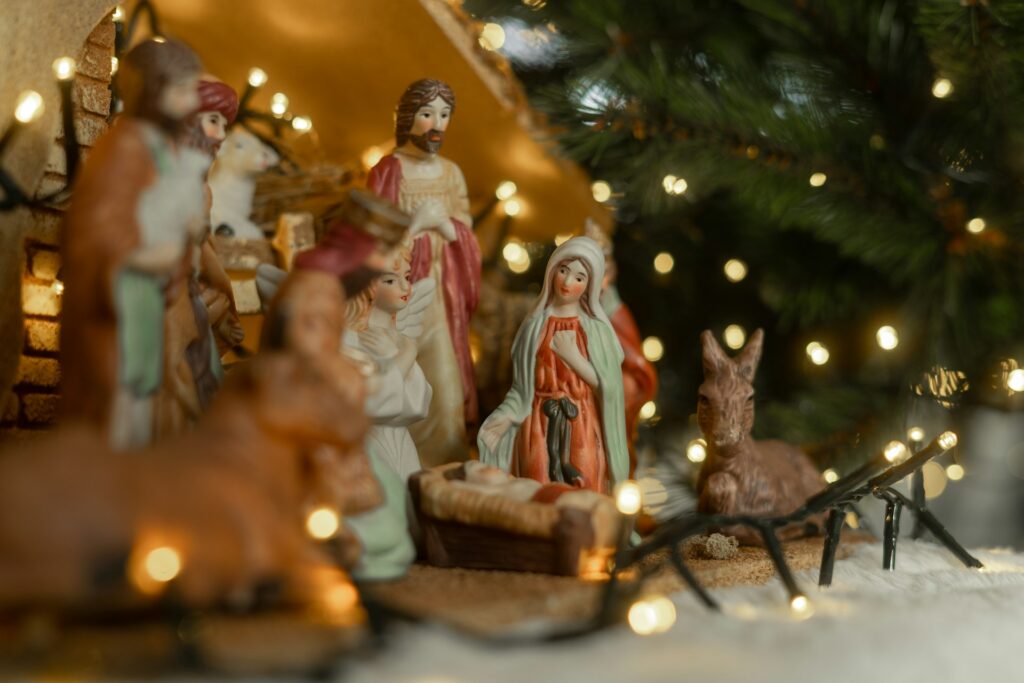
The famous living Nativity scene was staged by Francis of Assisi at Christmas 1223, in a cave near the Italian town of Greccio, and the event is often cited as the starting point in the history of Nativity scenes. The custom spread from Italy to France, and today crèches are set up in churches, stores, and many homes.
In Provence, the Nativity is populated by santons, clay figurines whose name comes from the Provençal santoun, “little saint.” Beyond the Holy Family, the shepherds, and the Magi, there’s a baker, a fishwife, a miller, the village priest, and the mayor — an entire Provençal village come to worship the child. Santons are handed down through generations, with new ones added every year. In December they’re sold at Paris’s Christmas markets, and the Nativity scenes themselves stand in the city’s churches (see our guide to Christmas in Paris).
Christmas Eve dinner and the bûche de Noël
The main evening of a French Christmas is December 24, the night of the réveillon. The name is related to the French verb réveiller, “to awaken,” and reflects the tradition of staying up late for the Christmas Eve meal: it once meant the supper after Midnight Mass. Church bells called worshippers to the night service, and afterward families went home to the table. Today Mass is often held before midnight, and dinner starts in the evening and stretches late into the night. Children find their presents on the morning of the 25th.
The menu varies from family to family and region to region, but traditional Christmas dishes include:
- champagne or a kir royal — champagne with black-currant liqueur;
- oysters and foie gras, the two great festive starters;
- turkey, capon, or goose, often with chestnuts;
- a cheese board;
- the Christmas log cake for dessert.
Provence keeps a special Christmas custom: a meatless supper called the gros souper ends with thirteen desserts, for Christ and the twelve apostles. Among them are four kinds of nuts and dried fruit, the quatre mendiants, or “four beggars,” representing the mendicant monastic orders. Alongside them come white and black nougat, dates, seasonal fruit, and a sweet bread made with olive oil, with the exact lineup depending on the village and the family. Oysters and foie gras, by the way, return to the table a week later: dinner on December 31 is also called réveillon.
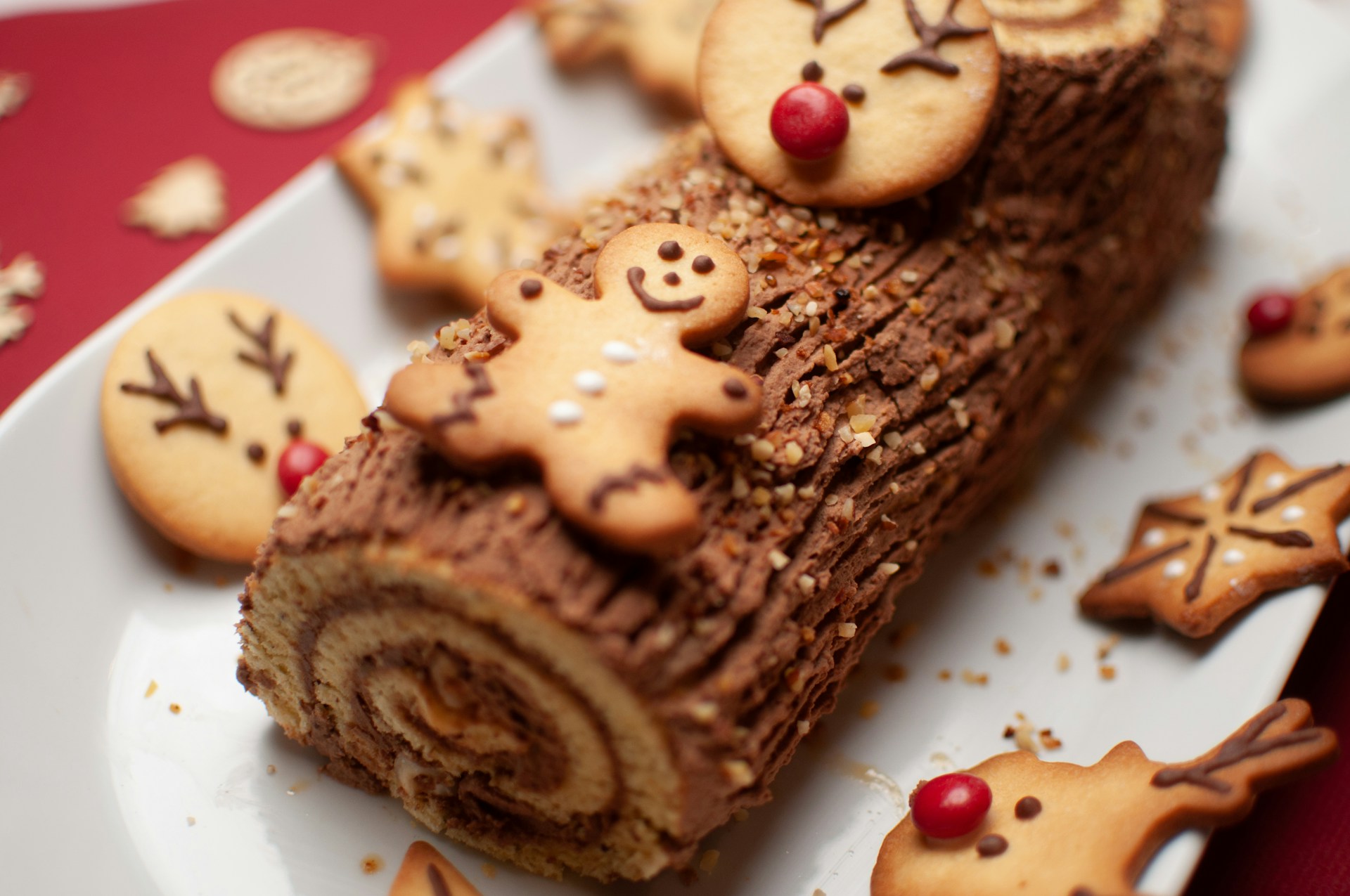
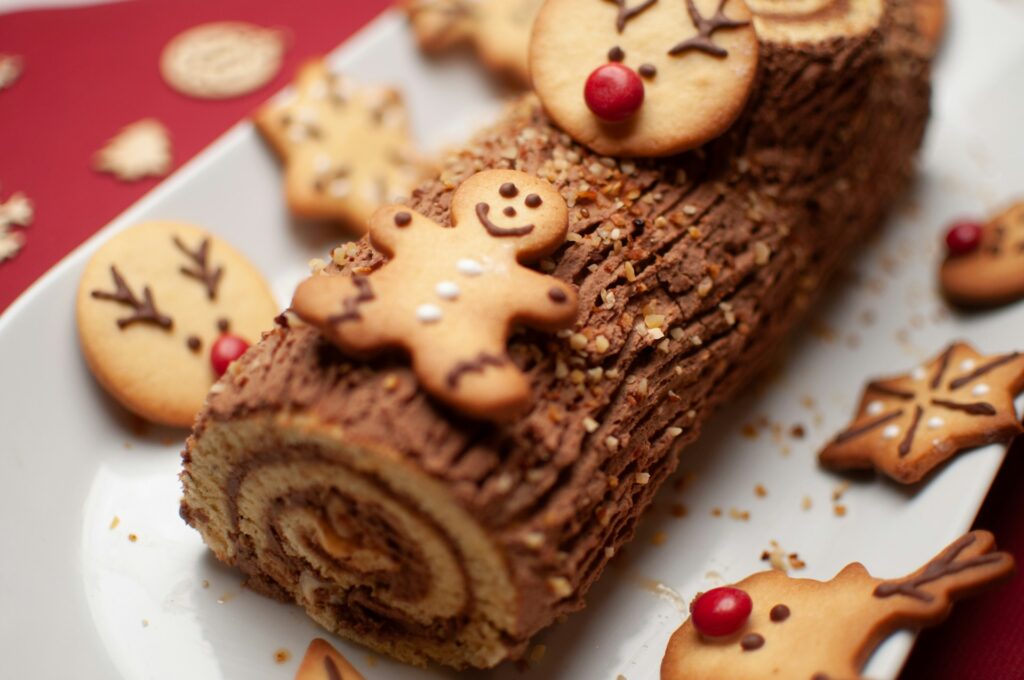
The Yule log was a real one at first. In country villages, a big log was laid on the hearth on Christmas Eve, and people tried to keep it burning as long as possible; its ashes were saved in the belief that they would bring luck to the next harvest. Over time the tradition of burning a Christmas log at home gradually declined, and French pastry tradition gave rise to an edible one, the bûche de Noël: a sponge roll filled with cream and covered in chocolate to look like bark, sometimes topped with sugar mushrooms and a tiny hatchet. Today Parisian pastry chefs and the chefs of the grand hotels compete every December to create the most unusual bûche, and sometimes the name is the only thing these elaborate desserts have in common with the original log.
Mistletoe and holly
Mistletoe has a long history. The Roman writer Pliny the Elder described how Gaulish druids revered it and cut it from oak trees. Beliefs in its healing and protective powers came later, in folk tradition, and the custom of kissing under it is younger still. In France, people kiss under mistletoe less at Christmas than at midnight on New Year’s Eve, and the old greeting goes au gui l’an neuf — “to the mistletoe, the new year.”
Holly, with its prickly leaves and red berries, is often woven into Christmas wreaths. The thorns recall the crown of thorns, the berries the blood of Christ. According to legend, when the Holy Family fled to Egypt from King Herod, holly bushes spread their branches to hide them, and in gratitude the Virgin Mary promised that holly would stay green all year round.
A holiday for family
The sociologist Évelyne Favart studied family Christmas gatherings using interviews collected by students at the University of Liège. Her research shows that the holiday helps keep generations connected but demands constant negotiation: where to gather, whose family to visit, how to divide the time between relatives. While the older generation is alive, families most often go to them, and at the table old grudges are often left unspoken so as not to spoil the evening.
All this happens behind closed doors. A traveler rarely gets invited to a family Christmas dinner, but traces of these home traditions are everywhere in Paris. Alsatian gingerbread and Christmas trees, Provençal santons in the Nativity scenes, chocolate shoes in the shop windows, lines for oysters outside the fishmongers, and lit windows on the evening of December 24: traditions from all over France meet in Paris. And behind them lies the reason the holiday exists at all — the wish to gather everyone close at one table, at least once a year. If you’re in the city that evening, a one-hour illuminations cruise on the Seine shows the lit-up city from the water.
Continue exploring
- Christmas in Paris 2026: lights, markets and decorations
- New Year’s Eve in Paris 2027
- Paris in January and February: what to do after Christmas
- Marais Quarter Historical Food Tour — TouringBee audio guide
Disclosure: this article contains affiliate links to TouringBee and GetYourGuide. If you book through them, we may earn a small commission at no extra cost to you.