
No products in the cart.

How to Get to Hallstatt: Train, Ferry, Bus and Car
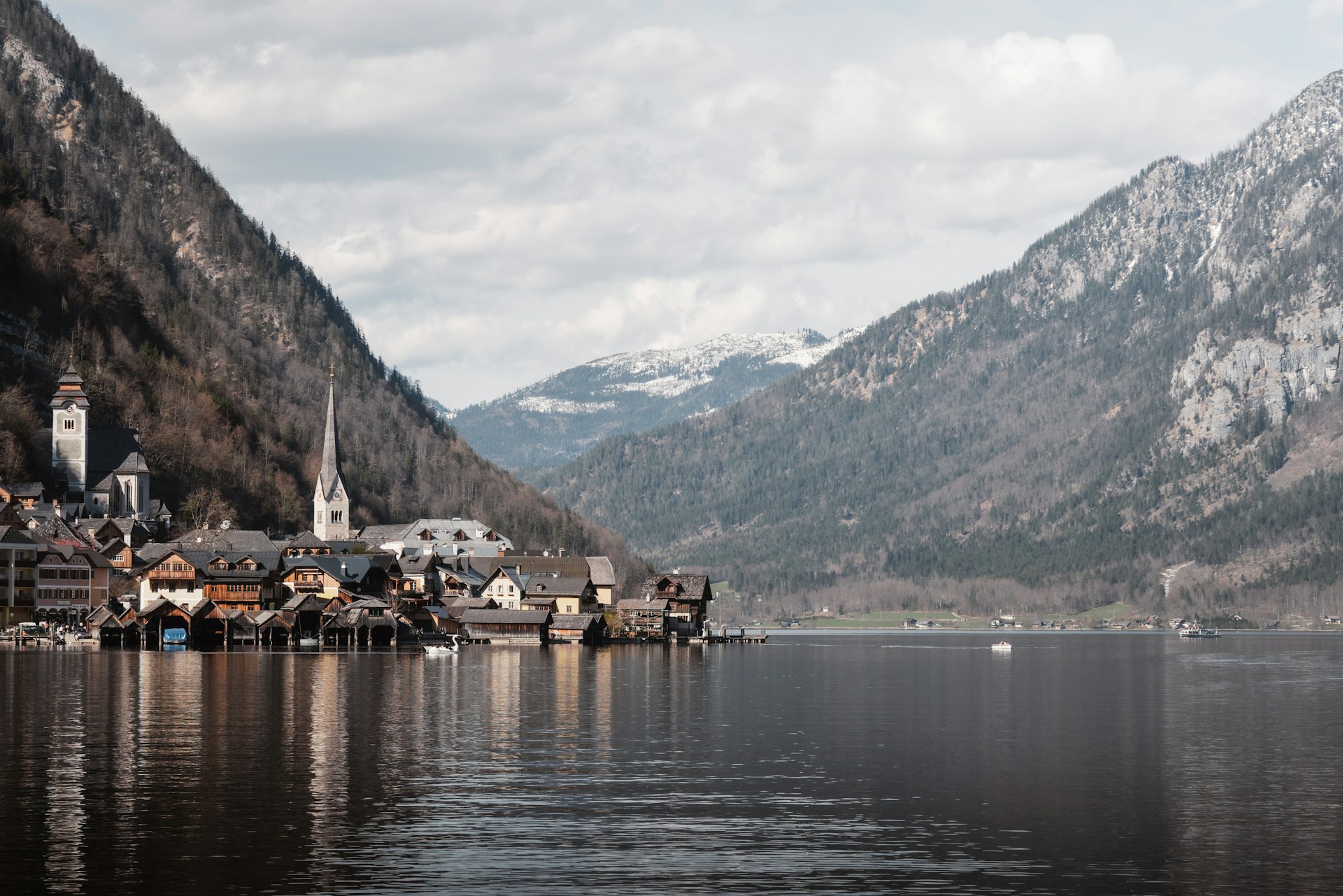
Most routes into Hallstatt have an awkward final leg — here’s how each one works and which to pick.

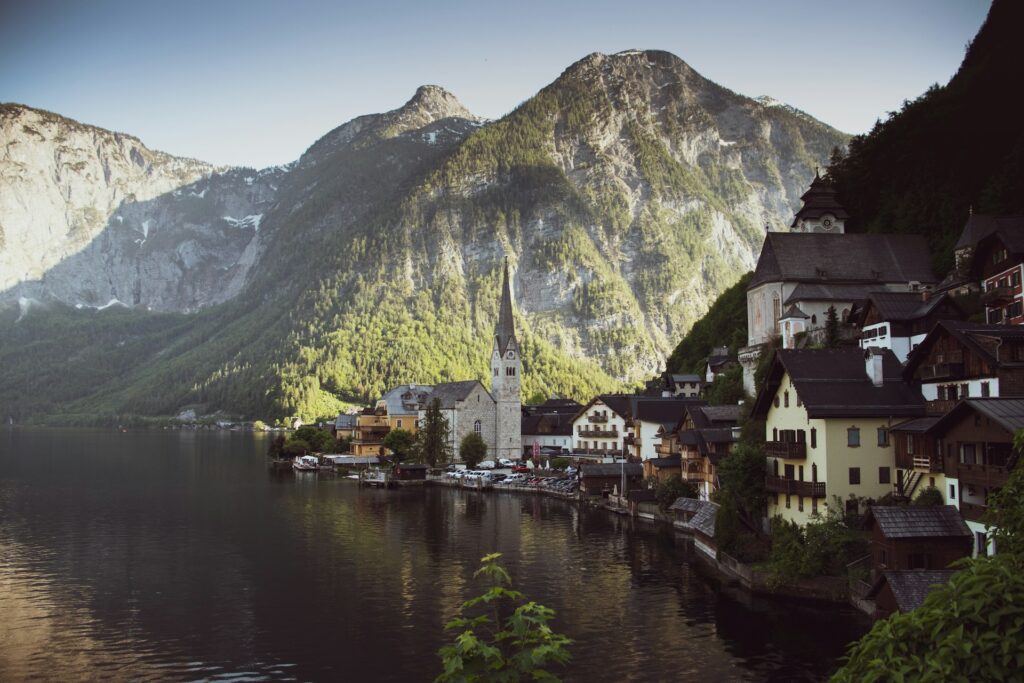
Hallstatt sits on a narrow strip of land between the Hallstättersee and a limestone wall. There was no road here until the 1870s; you came over the mountains or across the water. That geography still runs the whole trip. The railway was built on the opposite shore, the village center is closed to traffic, and the parking lots sit at the edges.
So the question isn’t really how to get to Hallstatt. It’s how the last twenty minutes work — the ferry, the barrier, the shuttle, the walk with a suitcase — because that’s the part people get wrong. Everything before that is a normal Austrian train or a pleasant drive.
If you arrive by bus or car, you approach the village from the Lahn end; the ferry from the station lands at Markt, in the center. The Lahn pier is also where our self-guided audio walk of Hallstatt begins, which makes it a natural first move if you come in by road and want a route through the center rather than a wander.
Quick answer
| Coming from | Best option | Roughly | Transfer at the end |
|---|---|---|---|
| Salzburg | Train via Attnang-Puchheim, or bus via Bad Ischl | About 2½ hours to the village either way | Ferry (train) / none (bus) |
| Vienna | Train; a through InterCity on many dates | ~3h10–3h50 | Ferry |
| Bad Ischl | Train or bus | ~30–45 min | Ferry (train) / none (bus) |
| Obertraun | Bus, train, boat or on foot | 15–30 min | Depends on the mode |
| By car, from anywhere | Drive to P1 or P2 and walk in | Salzburg ~1h15–1h30 | 15–20 minute walk |
Three names to keep straight, because they are three different places:
- Hallstatt Bahnhof — the railway station, on the eastern shore, across the water from the village.
- Hallstatt Markt — the ferry landing, in the historic center.
- Hallstatt Lahn — the southern end of the village: bus terminal, the lower station of the funicular, and the start of the lakeside promenade.
Where Hallstatt is, and why arriving is odd
Hallstatt is in the Salzkammergut lake district of Upper Austria — about an hour and a quarter from Salzburg by car, and three hours or so from Vienna. It is not on a main line and not on a motorway.
The Salzkammergut railway runs down the eastern side of the lake — the side with room for tracks. The village is on the western side, so the station opposite it is a single platform connected to the village by boat rather than by road.
The order of events explains the layout. A road between Gosaumühle and Hallstatt was completed in 1875, and the Salzkammergut railway opened in 1877 along the far shore. The shore had no room to spare then and has none now: today the center is closed to visitor traffic, and drivers park outside and walk in. None of this is a temporary inconvenience or a sign you’ve planned badly. It is what the site allows.
Getting there by train
Almost every itinerary changes at Attnang-Puchheim, on the Vienna–Salzburg main line, onto the regional Salzkammergut service toward Hallstatt. From the Graz and Styria side you approach from the other end, via Stainach-Irdning. The platform for the connection varies by service, so check the departure board rather than assuming you stay where you are.
From Salzburg the run to Hallstatt Bahnhof is about 2h15 on the quicker connections and closer to 2h40 when the second leg is an all-stops train; the crossing comes on top of that. From Vienna it’s roughly 3h10 to 3h50 depending on the connection, and on many dates there’s a through InterCity — morning out, early evening back — that skips the change entirely. It doesn’t run every day, and times shift with the annual timetable, so check your own date rather than a general description.
Advance saver fares are sold for specific trains and can be much cheaper than buying on the day, with the trade-off that you’re locked to that departure and that the cheapest allocations are limited.
Hallstatt Bahnhof has a ticket machine but no staffed counter and no lockers. It’s a platform, a shelter and a path down to the boat.
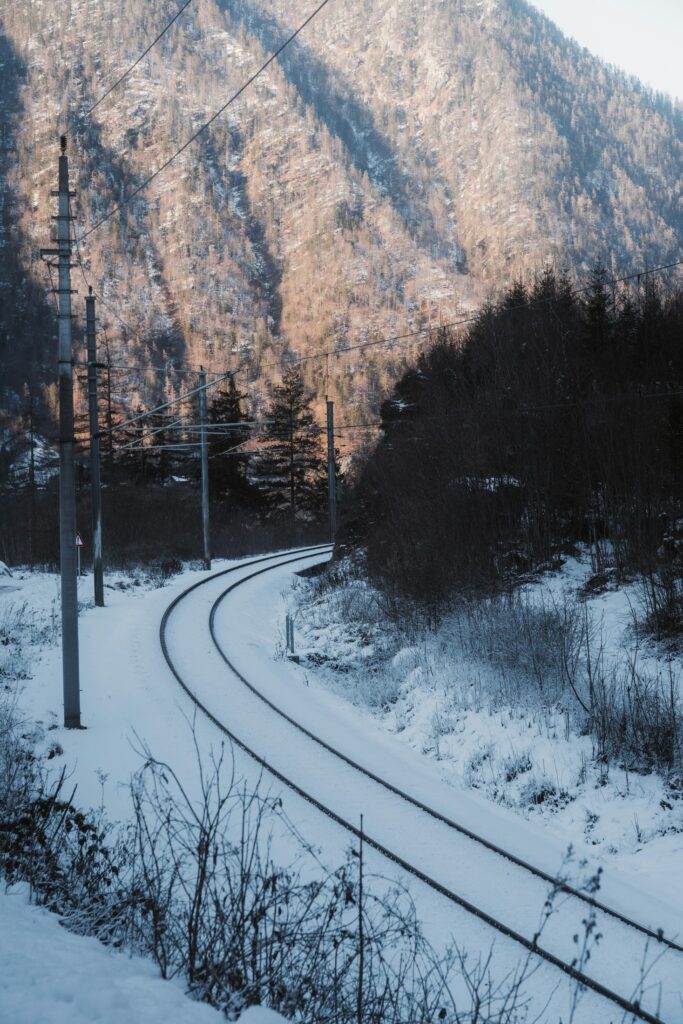
The station is across the lake, and that’s normal
There is no bridge and no short road connection between the station and the village. For a normal arrival, the ferry is the practical link. Trains and ferry are scheduled against each other, so the crossing is part of the journey rather than an extra you need to arrange.
The ferry: how it actually works
The ferry between Hallstatt Bahnhof and Hallstatt Markt runs all year, every day, timed to train arrivals and departures. The crossing takes under ten minutes and the landing is a few steps from the market square.
Four things worth knowing before you’re standing on the jetty:
- Cash only. The ferry ticket is separate from your train ticket, and the boat takes cash. Bring notes or coins.
- Departures are set against the trains, and the operator may adjust them when a train is delayed — which is not the same as a promise that a boat waits for every late arrival. If your train is running well behind, check the posted times.
- Evening service ends early. The last crossings are in the early evening, not at night. If you’re catching a late train out, work backward from the boat, not the train.
The operator publishes separate timetables for each direction, so check the current version for the way you’re traveling. For bikes, strollers or step-free boarding, check with the operator, since not every vessel on the lake is the same boat.
Getting there by bus
The bus network reaches Hallstatt through Bad Ischl, which is the hub for the whole area.
From Salzburg, routes 150 and 150X leave from the bus terminal beside the main station and run to Bad Ischl past Fuschlsee and Wolfgangsee — roughly an hour and a quarter to an hour and a half depending on the service, with departures through the day. In Bad Ischl the bus stops in front of the railway station, so you can continue by bus or switch to the train there.
Continuing by bus means one more change, normally at Gosaumühle, onto the service that runs down the western shore into the village. The whole Salzburg–Hallstatt trip lands around 2.5 hours. Line numbers move around between directions and timetable changes, so use the regional journey planner and the destination display rather than memorizing a number.
The advantage over the train is that the bus stops at Hallstatt Lahn, inside the village, with no ferry crossing. The trade-offs are two changes along the way, a connection at Bad Ischl that isn’t always tight, and unreserved seating. Tickets can be bought from the driver or in advance in the regional transport app — not every regional bus has a card terminal, so carry cash if you plan to buy on board.
The same service continues past Hallstatt toward the Dachstein cable car and Obertraun, which makes it the simplest link to the mountain — about a quarter of an hour from Lahn. The salt mine tours start from the funicular at the same Lahn end, so a bus arrival puts you right next to them.
Arriving by car
Driving is the fastest way here and the one that needs the most planning at the end.
From Salzburg it’s roughly 1h15 to 1h30, about 75–80 km by road, on B-roads through Bad Ischl and Bad Goisern. From Vienna it’s around 3 hours. Add the walk in from the parking lot on top of any door-to-door estimate your navigation app gives you.
Parking: which lot and how it works
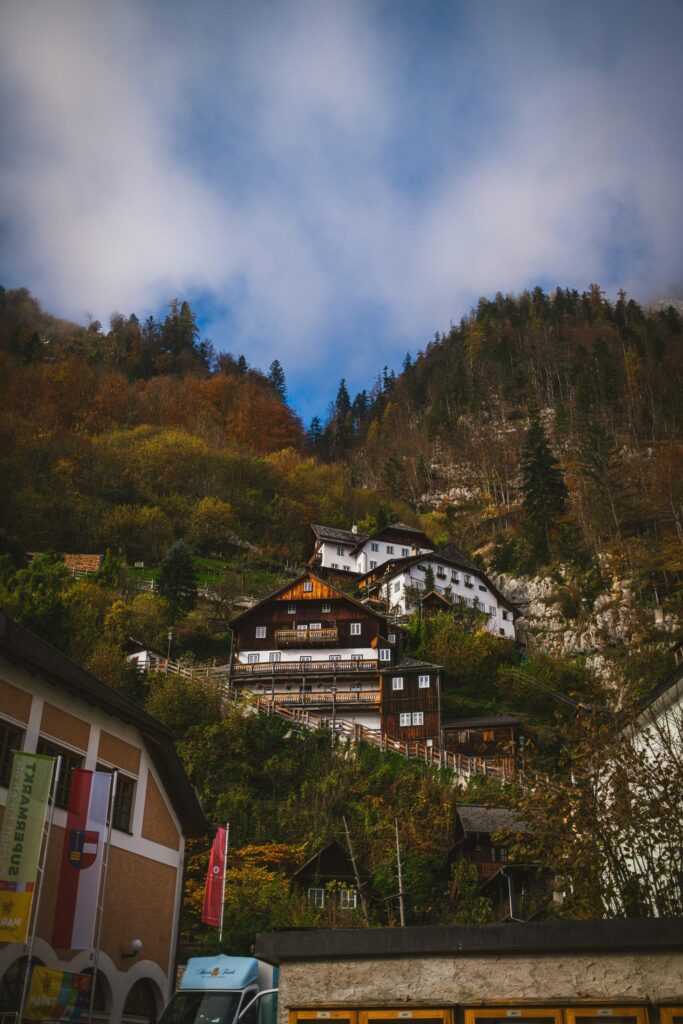
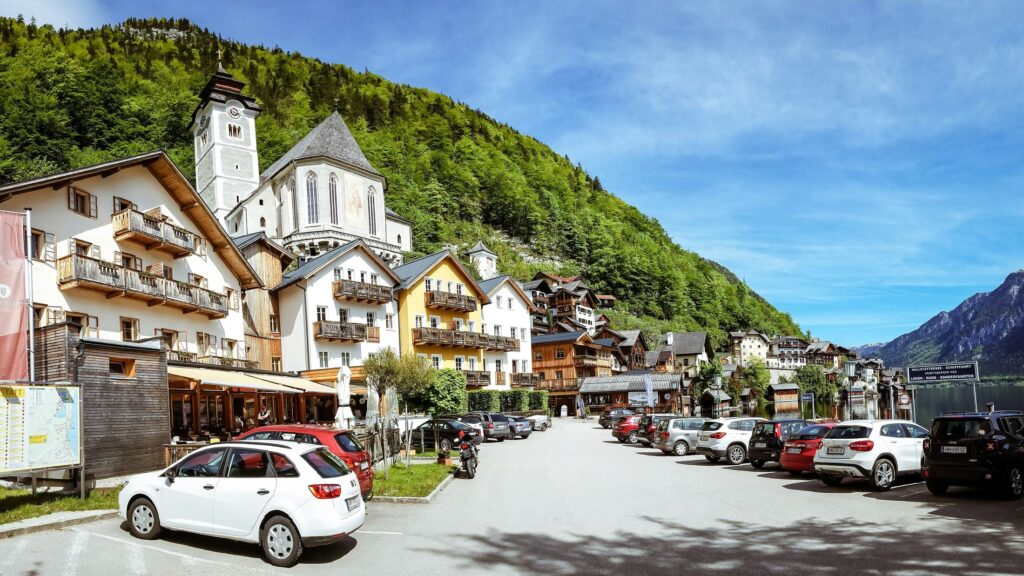
The center is closed by barrier systems. Day visitors park in the numbered lots along the road and walk.
| Lot | Open | Walk to the center | Notes |
|---|---|---|---|
| P1 | All year | ~20 min | Multi-story, just past the gas station; where hotel tickets are issued |
| P2 | Seasonal | ~15 min | Closest to the funicular and the salt mine access |
There are further lots outside the village. If the signage or the display boards send you to one of them, follow them rather than looking for a space closer in.
The 2026 tariff in the numbered lots is the same everywhere: the first 15 minutes are free, then €5 for an hour, €9 for two, €10 for three to four, €12 for five to six, €15 for seven to twelve, and €20 for a day ticket. A lost ticket costs €40.
Spaces cannot be reserved. Electronic boards along the approach road show what’s free, so you can see whether to stop or drive on before you commit to a turn-in. If you’re staying overnight in the center, that’s a different system — see below.
Winter tires are required for vehicles up to 3.5 metric tons from 1 November to 15 April whenever road conditions are wintry.
Why you can’t drive into the center
Two barriers close the historic center to through traffic. There’s no drop-off inside, no five-minute exception for luggage, and no way to talk your way past.
Guests booked into accommodation in the center without its own parking use a separate arrangement: park at P1, register at the Hotel-Shuttle Info Point, and a shuttle takes you and your bags to the accommodation. The shuttle runs 09:00–19:00. Hotel parking tickets are priced per day on a sliding scale that gets cheaper the longer you stay. If your accommodation is outside the restricted center and has parking of its own, follow your host’s instructions — ask before you arrive rather than after. (Not sure where to base yourself? See Where to Stay in Hallstatt.)
Between Hallstatt and Obertraun
Obertraun is the next village around the lake and the base for the Dachstein cable car. Four ways to move between them:
- Bus — the most direct: Hallstatt Lahn to the cable car valley station in about a quarter of an hour, and around twenty minutes to stops in Obertraun itself.
- Train — one stop, but only from Hallstatt Bahnhof, so from the village it means the ferry first. It also puts you at Obertraun-Dachsteinhöhlen station, from which you still need the bus to the cable car.
- Boat — seasonal, and the crossing time depends on which service is running. More of an outing than a transfer.
- On foot or by bike — a lakeside path runs from Hallstatt along the southern shore straight to Obertraun; the eastern-shore trail is the continuation around the far side of the lake. Check current trail closures before a long walk or ride.
Luggage
Hallstatt Bahnhof has no lockers, and the village has stairs, cobblestones and a ferry in the middle of it. If you’re arriving and leaving on the same day with bags, deal with them first.
There are two official storage points: the valley station of the Salzbergbahn funicular at the Lahn end, and the tourist office. Both are in the village, which means you cross with your bags once and then move freely.
What doesn’t work well: a large suitcase on the ferry, up to the salt mine, or over cobblestones and stairs. If you’re on a long day between two cities, storing bags is worth the detour it costs you.
Which option to choose
| Your situation | Pick | Why |
|---|---|---|
| No car, coming from Salzburg | Train + ferry | Train and boat are timed to each other, and you land in the center |
| No car, and no ferry with your bags | Bus via Bad Ischl | Stops inside the village; two bus changes on the way |
| Avoiding the jetty with a stroller | Bus | No ferry transfer, at the cost of two bus changes |
| With luggage, moving on the same day | Train + ferry, bags stored on arrival | Storage is in the village, not at the station |
| Day trip, tight schedule | Train + ferry | Timed connections beat a parking search |
| Staying overnight in the center | Car to P1 + hotel shuttle | The shuttle exists precisely for this |
| Heading up to Dachstein | Bus | Direct to the cable car, no ferry in the middle |
Practical tips
- Screenshot the return connection before you lose signal, especially the last ferry.
- If you’re driving, follow the electronic boards on the way in and go to whichever lot they show as free.
- Check the ferry timetable that matches your travel direction — they’re published separately.
- If a connection at Bad Ischl or Attnang-Puchheim is under ten minutes, treat it as tight rather than guaranteed.
Common mistakes
- Booking accommodation “in Hallstatt” and driving straight to it. The center is behind barriers. Ask your host about parking before you set off.
- Planning the day from the train timetable alone. The ferry is a separate connection with its own last departure.
- Arriving with only a card. The ferry takes cash.
- Treating Hallstatt Bahnhof as a place to leave bags. No lockers, no staff.
- Assuming the station is a short walk from the village. It’s across the lake.
- Expecting to reserve a parking space. The lots are first-come; follow the electronic availability boards on the way in.
FAQ
Do I need a ticket to enter Hallstatt? No. Individual visitors don’t need an entry ticket. Tour buses use a separate pre-booked slot system, which doesn’t affect anyone arriving by train, scheduled bus, car or on foot.
Does the ferry run in winter? Yes. The station line runs year-round, every day, timed to the trains. Sightseeing cruises on the lake are the seasonal ones.
How often does the ferry run? It isn’t on a clock-face schedule — departures are set against train arrivals and departures, so the frequency varies through the day, and service ends in the early evening.
Can I get to Hallstatt without a car? Yes, and for a day trip it’s often the better choice. Train plus ferry from Salzburg takes about two and a half hours, and so does the bus via Bad Ischl.
Where do I park? P1 (all year) or P2 (seasonal) for day visits. Fifteen minutes free, €20 for a day ticket, no reservations. If the boards send you to a lot further out, follow them.
How long does it take from Salzburg? About 2h15–2h40 to Hallstatt Bahnhof by train, plus the crossing — call it two and a half hours to the village. Roughly the same by bus, and 1h15–1h30 by car plus the walk in from the lot.
Is there luggage storage? Yes — at the funicular valley station and at the tourist office, both in the village. Not at the railway station.
Continue exploring
- What to See in Hallstatt — a first-time visitor’s guide to the village, the mountain and the lake.
- Where to Stay in Hallstatt — village, Obertraun or Bad Ischl.
- Best Time to Visit Hallstatt — what runs in which season.
- Why Hallstatt Is Famous — salt, the Hallstatt culture and the Chinese copy.
- Hallstatt in Winter — what’s actually open.
- Our self-guided audio walk of the historic center, which starts at the Lahn pier.
Before you set off
Get the last two connections of your day fixed before you leave — the ferry back to the station, or the bus out of Lahn — and the rest of the trip stops being a logistics problem. Once you’re standing at the Lahn pier with a few hours ahead of you, the village is about a kilometer end to end and there’s more in it than the photographs suggest; a self-guided audio walk is one way to spend that stretch without a schedule to keep.
Disclosure: this article contains affiliate links to the TouringBee audio guide (a product of the company behind this site) and to GetYourGuide. If you buy through these links we may earn a commission at no extra cost to you.