
No products in the cart.

What to See in Hallstatt: A First-Time Visitor’s Guide
An inventory of what's actually in Hallstatt — the village, the salt mountain above it, the lake and the places nearby — with the time each one costs you.
An inventory of what’s actually here — in the village, above it, and around it — so you can decide what’s yours.
Hallstatt is smaller than its photographs suggest. The historic center is about a kilometer end to end, and you can walk from one end to the other in fifteen minutes without hurrying. That’s the first thing to know, because it reframes the question. It isn’t “how do I fit everything in.” It’s “which of these things do I actually want.”
This article is an inventory. It covers what exists in the village, what sits above it on the salt mountain, what’s on the lake, and what’s nearby but genuinely separate. Each entry says what the thing is and roughly what it costs you in time, so you can build a day from it rather than working through someone else’s list.
Because the distances are so short, the difference between an hour here and a real visit isn’t the number of sights. It’s how much of them you understand. Our self-guided audio walk covers the historic center from near the Lahn pier to the Place of Silence viewpoint, which is the stretch where that difference shows up most.
Quick answer
| Layer | What’s in it | Time it takes |
|---|---|---|
| The village | Market Square, two churches, the Bone House, the museum, the promenade | 2–3 hours for a proper look |
| Above the village | Salt mine, Skywalk, the high valley, the funicular | At least 3 hours as a block |
| The lake | Boat trips, rentals, swimming — the station ferry is a short crossing | From about an hour upward |
| Around Hallstatt | Dachstein caves, 5fingers, Obertraun | From about 2 hours for one attraction |
| Free | The center, the promenade, the churches, the excavation cellar, the viewpoints | Variable; some interiors have opening constraints |
What Hallstatt actually is
A village of fewer than 800 residents on a narrow strip between the Hallstättersee and a limestone wall, in the Salzkammergut lake district of Upper Austria. Above it is the Salzberg, the salt mountain, where salt has been produced for about 7,000 years. Across the water is the railway station; around the head of the lake is Obertraun, and above that the Dachstein plateau.
That’s the whole geography, and it explains the layout of a visit: everything at village level is walkable, everything above village level needs a lift or a climb, and everything across the water needs transport.
In the village itself
Market Square and the historic center
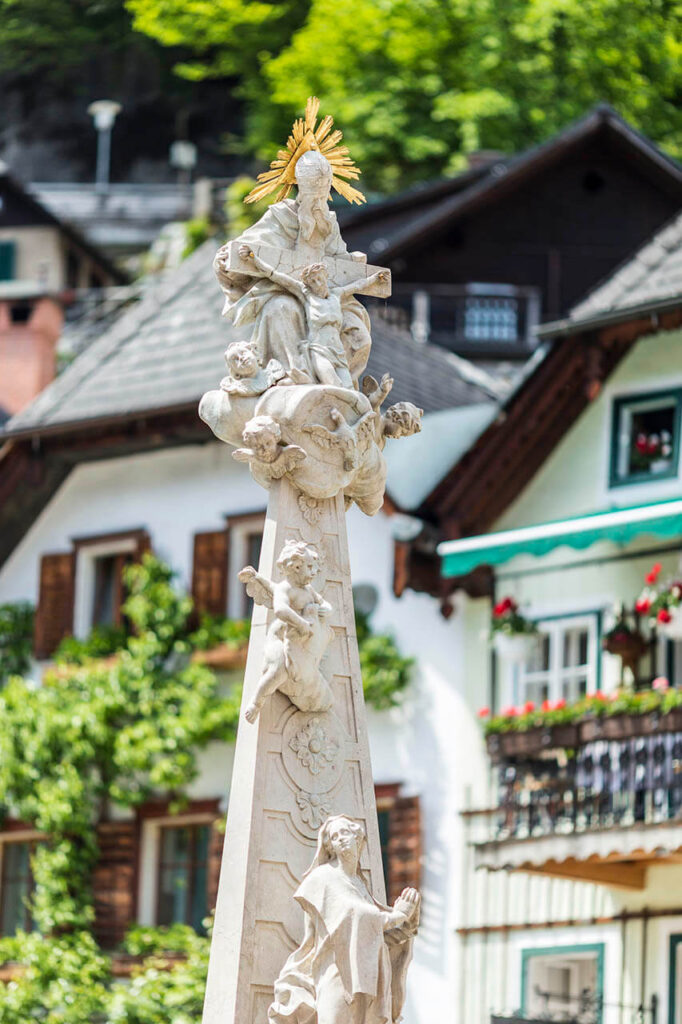
The square is the center of the village and the place most of it radiates from: historic houses around it, the 18th-century Holy Trinity Column in the middle, shops and cafés at the edges. The lanes running off it are short, steep in places, and mostly residential — people live here, and the balconies with the flowers belong to somebody. Allow twenty minutes to look at the square, more if you sit down.
The two churches
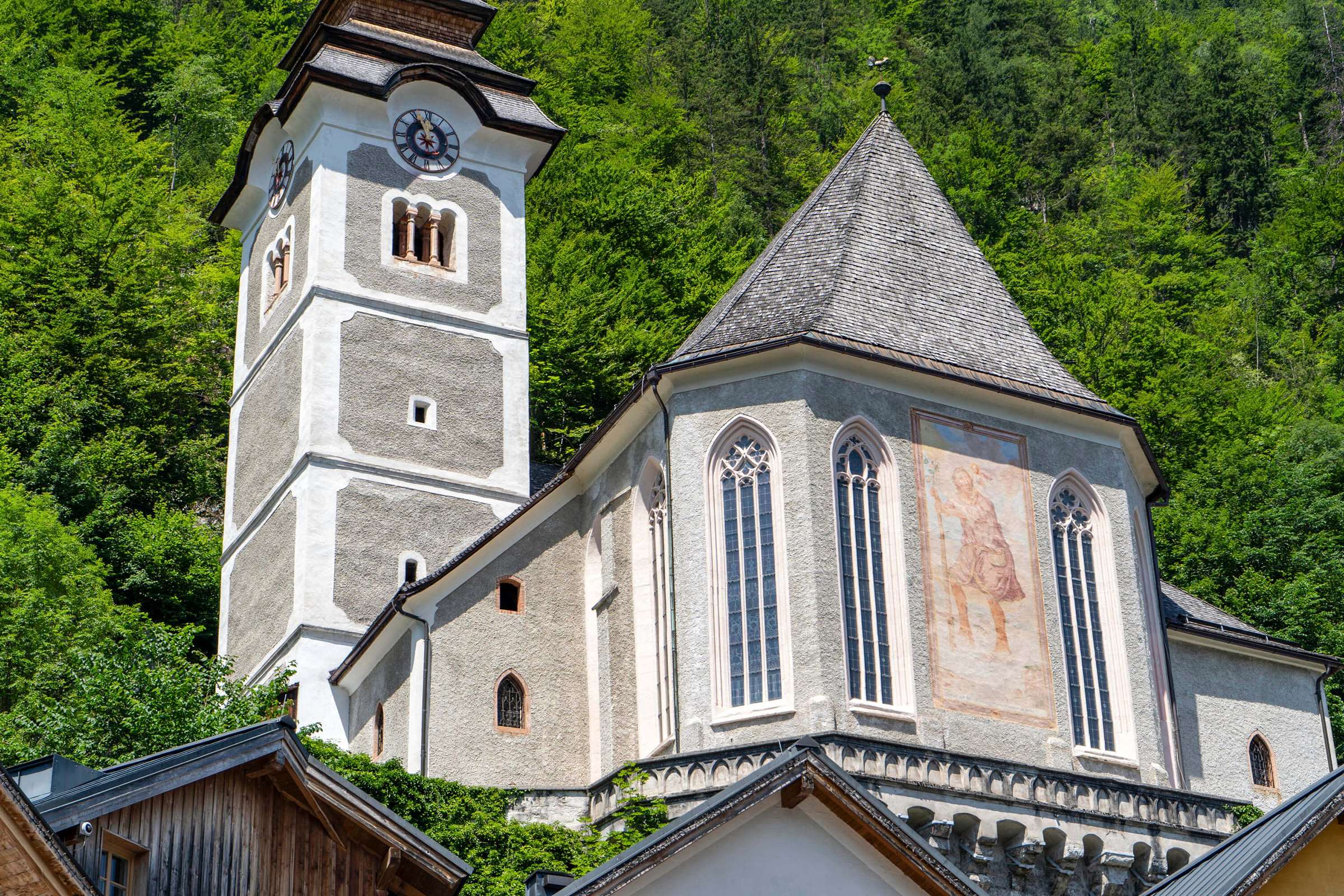
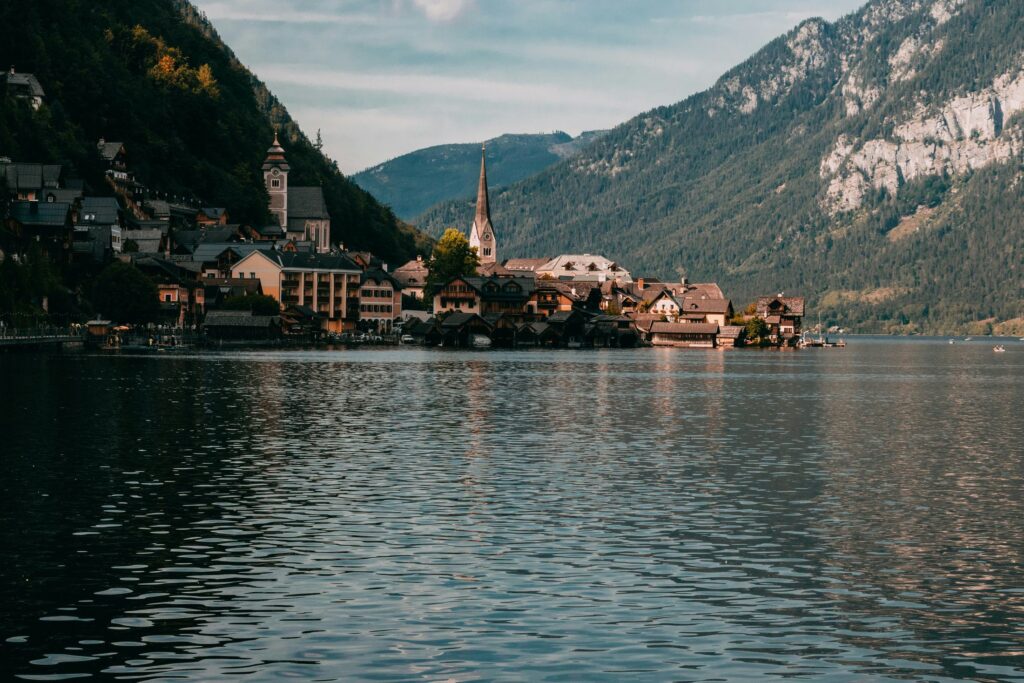
Two churches define the skyline and they’re a study in contrast. The Evangelical parish church, with the slim spire in the classic lake view, was completed in 1863 after five years of building; a plainer prayer house had stood on the site since 1785.
The Catholic parish church of the Assumption sits higher up, reached by stairs from the square. Its winged Marian altar dates from about 1515 to 1520 — early sixteenth century, by Leonhard Astl. Entry is free at both. Services take priority over sightseeing.
The cemetery and the Bone House
Beside the Catholic church is the cemetery, and in the crypt of the Chapel of St. Michael is the ossuary — the Bone House. It holds around 2,000 skulls, more than 600 of them painted and inscribed with names, dates, and flowers or leaves. There’s a small entry fee, the room is very small, and it remains a consecrated space rather than a museum. Twenty minutes covers it, and it isn’t for everybody.
The Hallstatt Museum
The World Heritage Museum on Seestraße runs through the village’s history in a sequence of stations, from prehistoric salt mining to the present. It’s small and indoor, and a good option in bad weather. Visitor information is in German and English. Allow about an hour.
Above the village: the Salzberg
The salt mountain is a separate block of the day rather than another stop in the village. The Salzbergbahn funicular climbs 325 meters from the valley station at the Lahn end — about three minutes — to the high valley, and it’s the normal visitor access. Walking routes exist and their status changes, so check current conditions first.
At the top: the Skywalk, also signposted as the World Heritage View, a platform projecting out over the roofs some 360 meters below; Rudolfsturm, the old defensive tower now a restaurant; the high valley with the prehistoric burial ground; and the entrance to the salt mine, a guided visit of its own. Allow at least three hours for the whole block, and dress for around 8 °C underground. Salt mine tickets are on GetYourGuide; booking ahead is strongly advised.
On the lake
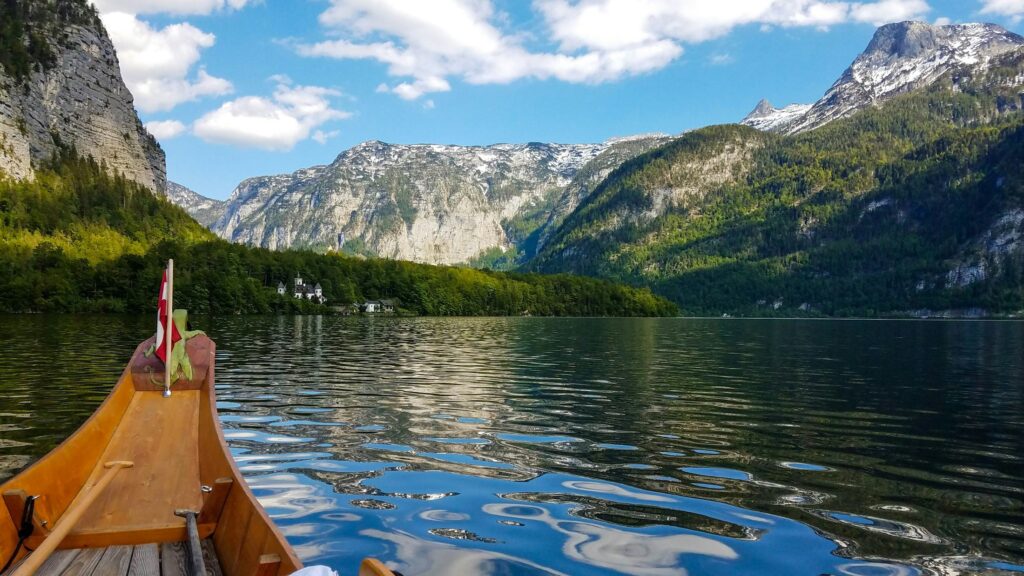
The ferry across to the railway station is a working transport link and also one of the easiest ways to see the village from the water. Beyond that: seasonal boat trips, boats to rent on the promenade in season, a free bathing area with a lawn and shallow water, and paths along the shore. An hour out on the water gives you a different village from the one you walk through.
The classic view, and the other viewpoints
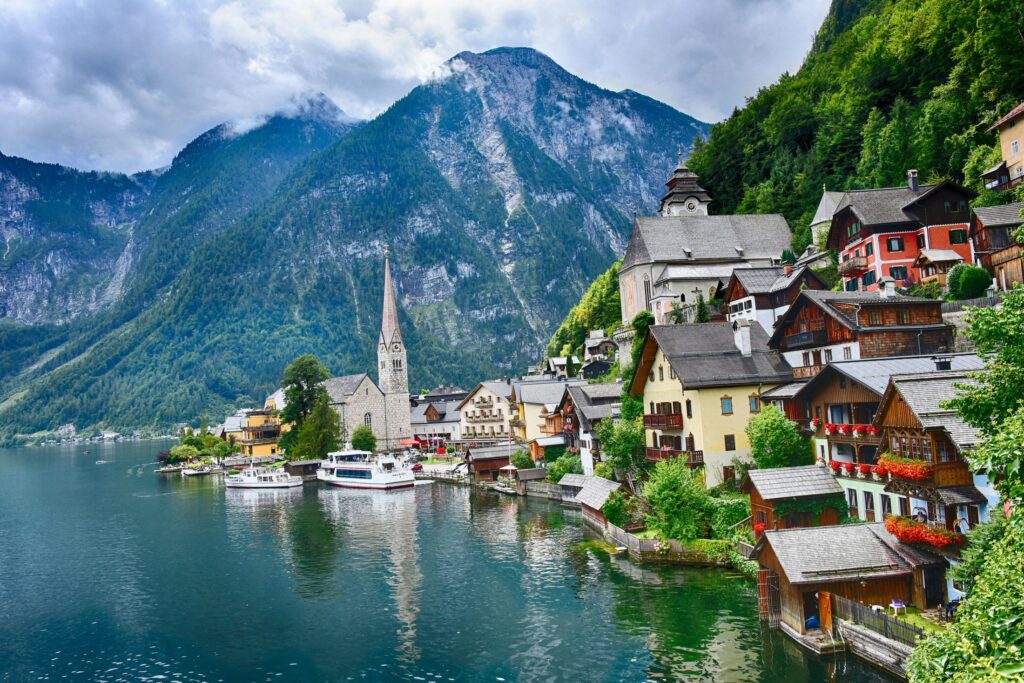
Hallstatt has one photograph, and then it has several genuinely different views.
| Viewpoint | Free? | Getting there | What it gives you |
|---|---|---|---|
| The classic view, north end | Yes | Level walk from the square | The postcard: houses, spire, lake, mountain |
| Place of Silence | Yes | On foot, north end | A small terrace with the same outlook |
| Skywalk (“World Heritage View”) | Platform free; funicular paid | Funicular from Lahn | The village from directly above |
| From the water | Boat fare | Ferry or boat trip | The full waterfront profile |
| 5fingers, Krippenstein | Cable car | Obertraun, separate trip | The Dachstein plateau, not Hallstatt |
The classic viewpoint sits in a residential lane. People live in the houses you’re photographing, which is worth remembering at eight in the morning.
Around Hallstatt
Two things get sold as Hallstatt attractions and are not in Hallstatt. Dachstein Krippenstein — the Giant Ice Cave, the Mammoth Cave, the 5fingers platform — is above Obertraun, reached by a cable car with its own seasonal calendar. The 5fingers platform on its own is about two hours including the cable car; adding a cave turns it into a much longer block.
Koppenbrüller, the youngest of the Dachstein caves, is down in the valley: about 15 minutes on foot from Koppenrast, then a guided tour of around 50 minutes. It runs seasonally, so check before you go.
What you can see for free
- The historic center and Market Square
- Both churches, when services aren’t in progress
- The lakeside promenade and the classic viewpoint
- The Place of Silence and the cemetery
- The bathing area in season
- The archaeological excavations under the Dachsteinsport Janu shop
That last one is worth a paragraph. In an emergency excavation between 1990 and 1994, the ground beneath the sports shop opposite the museum turned out to hold a complete sequence of layers from the present day back to prehistory — a salt-works forge, the outer walls of the Habsburg court from the High Middle Ages, and older material still. The cellar is about 300 square meters, and you can walk down and look at it during shop hours at no charge.
What each thing costs you in time
| Thing | Time |
|---|---|
| Historic center, walking the route | About 1–1.5 hours |
| The village with an interior stop or two | 2–3 hours |
| Bone House | About 20 minutes |
| Hallstatt Museum | About an hour |
| Salt mine and Skywalk, as a block | At least 3 hours; be at the valley station 45 minutes before the tour |
| Time on the lake | From an hour upward |
| 5fingers platform on its own | About 2 hours including the cable car |
| Koppenbrüller cave (seasonal) | 15-minute walk in, ~50-minute tour |
Practical things worth knowing
- Cash. The station ferry takes cash only. Elsewhere it varies, so carry some.
- The center is closed to traffic. Day visitors park outside and walk in.
- Drones. The village asks visitors to refrain from flying over it. Check Austro Control’s Dronespace for current rules.
- Stairs. The churches, the ossuary and the upper lanes are not at lake level. Wear shoes for cobblestones.
- Children. The mine admits children from age 4; the funicular, ferry and boats are the other draws.
Common mistakes
- Treating Dachstein as part of the village. It’s across the lake and above it, with its own transport and season.
- Assuming everything keeps the same hours. The museum, the Bone House and the mine are separate operations.
- Arriving without a ticket for the mine. Book ahead; the block takes at least three hours.
- Walking the center without knowing what you’re looking at. The interesting part is invisible without context.
FAQ
Do I need a ticket to enter Hallstatt?
No. The village is open; individual visitors walk in freely.
How much time do I need in Hallstatt?
The walk through the historic center takes about an hour to an hour and a half, or two to three hours once you add interiors and pauses. Everything else has its own time cost — see the table above.
What can I see for free?
The historic center, both churches, the promenade and street-level viewpoints, the cemetery, and the excavation cellar under the Janu shop.
How long does the salt mine take?
At least three hours in total, including the funicular. The block starts 45 minutes before the time on your ticket.
What’s the difference between the Skywalk and the classic viewpoint?
The Skywalk is on the salt mountain, reached by funicular, looking down on the village. The classic viewpoint is at street level at the north end, free, and it’s the photograph you already have in mind.
What if it rains?
The museum, the excavation cellar and the salt mine are the strong wet-weather options; the mine sits at about 8 °C whatever the weather.
Continue exploring
- Why Hallstatt Is Famous — salt, the Hallstatt Culture and the Chinese copy.
- Where to Stay in Hallstatt — village, Obertraun or Bad Ischl.
- Hallstatt in Winter — what’s open from November to March.
- Our audio walk through the historic center.
Tickets: salt mine tours and the Hallstatt Museum on GetYourGuide.
Where to start
That’s the whole inventory: a kilometer of village at lake level, a salt mountain above it, a lake in front, and a separate mountain world across the water. The village itself is older and stranger than it looks from the far shore, and it doesn’t take long to reach.
Disclosure: this article contains affiliate links to the TouringBee audio guide (a product of the company behind this site) and to GetYourGuide. If you buy through these links we may earn a commission at no extra cost to you.