
No products in the cart.

Medieval Vienna: What Survives and What You Can Actually Get Into
What's actually left of medieval Vienna, which doors open, and what a locked church usually means. Museum Judenplatz, the Gothic churches, the old-town lanes — with hours, costs and the closures nobody mentions.
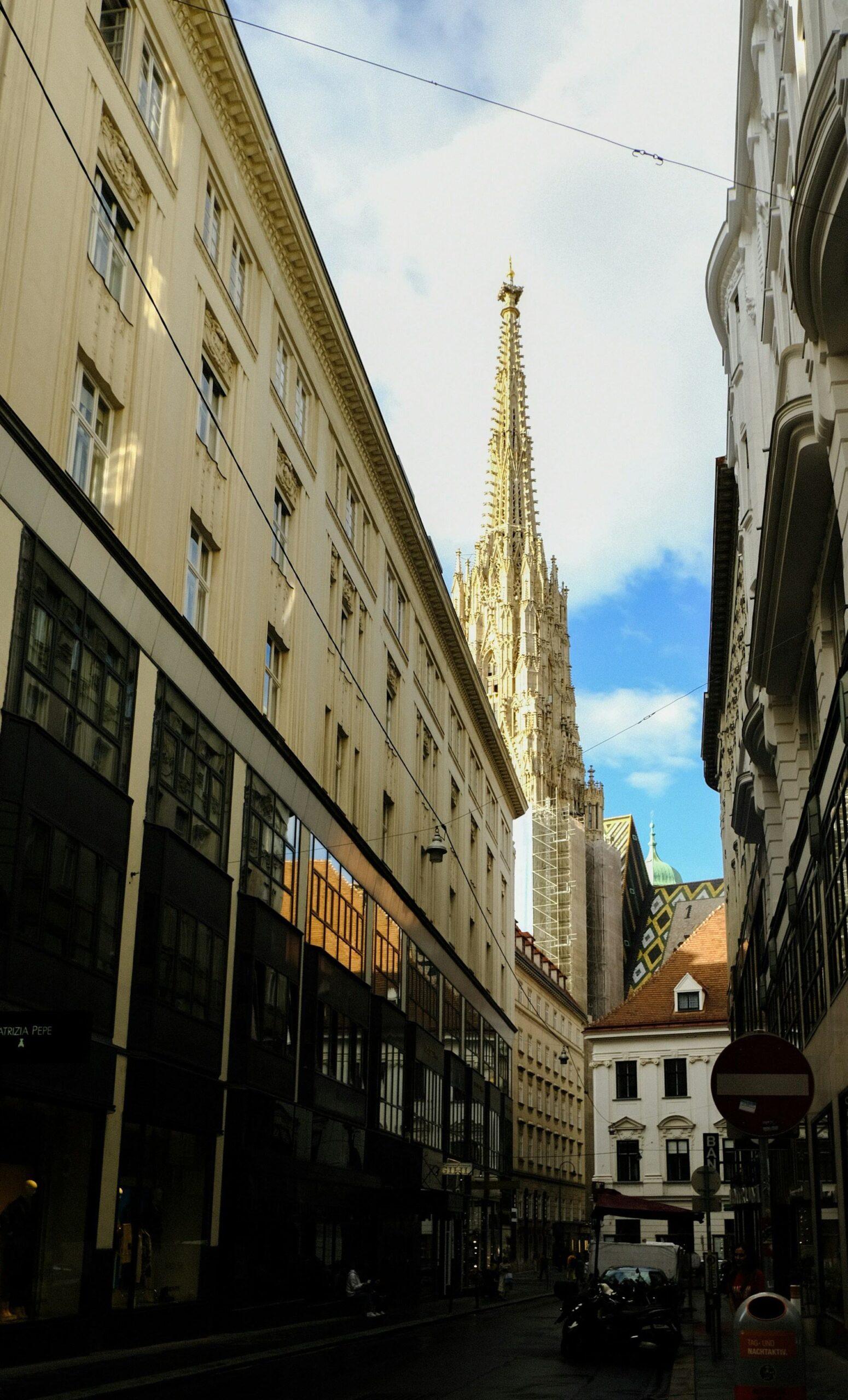
What’s actually left of the medieval city, what you can get inside, and what a locked door usually means here.
Much of medieval Vienna was absorbed into later rebuilding. The Baroque boom after 1683 refaced many medieval buildings and sites, and the demolition of the later fortification belt after 1857 removed the continuous visible ring of defences. What survives is fragmentary, scattered, and mostly not signposted.
It’s also more accessible than it looks, once you know where to go — and considerably less accessible than most guides suggest, because several of the best pieces sit behind irregular opening hours or are currently closed. This article is organised around getting in rather than around chronology. Much of the medieval street pattern is still legible in today’s first district — the compact area our self-guided audio tour of Vienna’s historic centre covers on foot — and what follows is what to do when you want to go inside something.
Quick Answer
| Best paid visit | Museum Judenplatz — excavated medieval synagogue foundations under the square |
| Oldest surviving church | Ruprechtskirche, probably founded in the early ninth century |
| Gothic interiors | St Stephen’s for scale; Maria am Gestade and the Minoritenkirche for quieter visits |
| Free | Ruprechtskirche, Maria am Gestade, the Minoritenkirche, the Deutschordenskirche, general entry to St Stephen’s, the lanes, and Judenplatz itself |
| Two small Wien Museum sites | The Virgilkapelle under Stephansplatz station and the Neidhart Festsaal on Tuchlauben — both currently closed |
| Partly medieval | The cathedral catacombs: mostly eighteenth-century burials, but including the medieval Ducal Crypt |
| Time needed | Half a day for the cluster with one paid interior and several short stops |
Museum Judenplatz: The One Worth Prioritising
If you pay for one medieval site in Vienna, make it this one. It’s also much less obvious to a first-time visitor than the cathedral or the surviving churches.
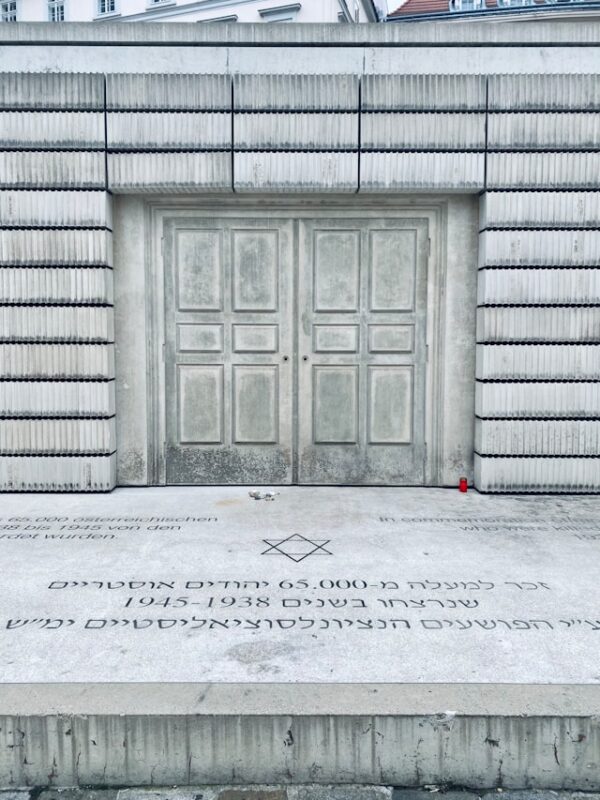
Beneath the square are the excavated foundations of a synagogue destroyed in 1421 during the persecution known as the Wiener Gesera, which ended Vienna’s medieval Jewish community through expulsion, forced conversion and killing. The permanent exhibition covers daily life in the medieval city as well as the site itself, with a 3D reconstruction of the building. Above ground, on the same square, stands Rachel Whiteread’s Holocaust memorial.
Three layers of Jewish history and memory in one small square.
- Practical. Sunday to Thursday 10:00–18:00, Friday to 17:00, closed Saturdays. Admission is around €15, and the ticket also covers the Jewish Museum on Dorotheergasse within seven days; under-19s enter free. Allow an hour here, longer if you’re doing both sites.
The Two Small Wien Museum Sites
Both are small, both are unusually revealing, and both are closed at the time of writing — worth remembering, because when they reopen they’ll be among the most distinctive medieval stops in the centre.
- The Virgilkapelle sits directly under the Stephansplatz U-Bahn station, reached by a spiral staircase from the concourse. It’s a thirteenth-century chapel, buried and forgotten for nearly two hundred years until subway construction uncovered it in 1973. Alongside it is a compact exhibition on medieval Vienna.
- The Neidhart Festsaal at Tuchlauben 19 is an early fifteenth-century dance hall with the oldest surviving secular wall paintings in the city — not saints, but a spring festival, a dance and a banquet, commissioned by a cloth merchant for his own house. They show medieval Viennese clothing, food, music and social tensions, which few other surviving sites preserve so vividly. The entrance to the exhibition space is 66 centimetres wide, so it isn’t accessible with a wheelchair or a pushchair.
The Virgilkapelle is closed for restoration; the Neidhart Festsaal is temporarily closed. Neither has an announced reopening date, so check before making a special trip.
The Free Churches
Several of Vienna’s important medieval churches sit close to the central sights and don’t charge admission. St Stephen’s is the partial exception: you can enter the church itself for free, but the dedicated sightseeing route is ticketed, and the towers and catacombs are priced separately again.
A locked door here usually means timing, not permanent closure. These are working churches with narrow opening windows, and access can disappear for a service or a funeral.
- Ruprechtskirche, on a small terrace above the Danube Canal, is the oldest surviving church in the city. Tradition puts its founding at 740; current scholarship favours the early ninth century, and the oldest surviving fabric dates from the twelfth. It’s small, dark, ivy-covered and completely unlike anything else in the centre. Opening hours are short and irregular, so treat getting inside as a bonus rather than a plan; the exterior and the square are the reason to walk there anyway.
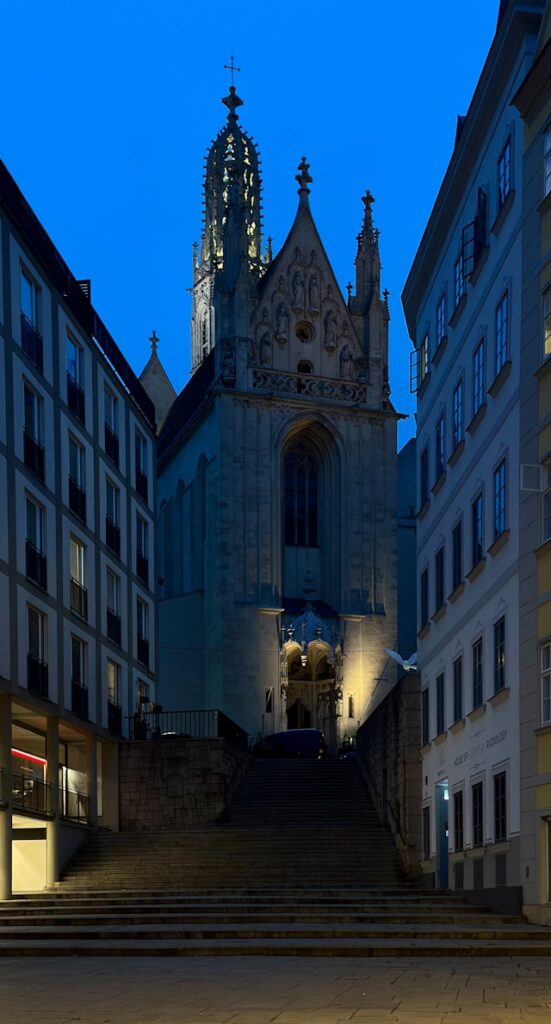
- Maria am Gestade stands above what was once a branch of the Danube, with a seven-sided openwork spire that reads as more delicate than anything on the cathedral. Fourteenth century, and free to enter.
- The Minoritenkirche is a Gothic hall church on a quiet square behind the Hofburg. Its oddity is a full-size mosaic copy of Leonardo’s Last Supper, commissioned by Napoleon and eventually installed here.
- The Deutschordenskirche sits just behind St Stephen’s and is easy to miss. The church itself is free to enter, while the small Treasury of the Teutonic Order next door is separately ticketed and opens on much more limited days.
- St Stephen’s Cathedral is the obvious one and gets its own guide. Worth flagging here: most of what visitors picture as the catacombs dates from after the graveyard closed in 1732 — mass burial chambers rather than the Middle Ages. The complex does include the medieval Ducal Crypt, where Rudolf IV, who died in 1365, and other medieval Habsburgs are buried.
The Street Pattern Is the Monument
This is the part that costs nothing and that most people walk through without registering.
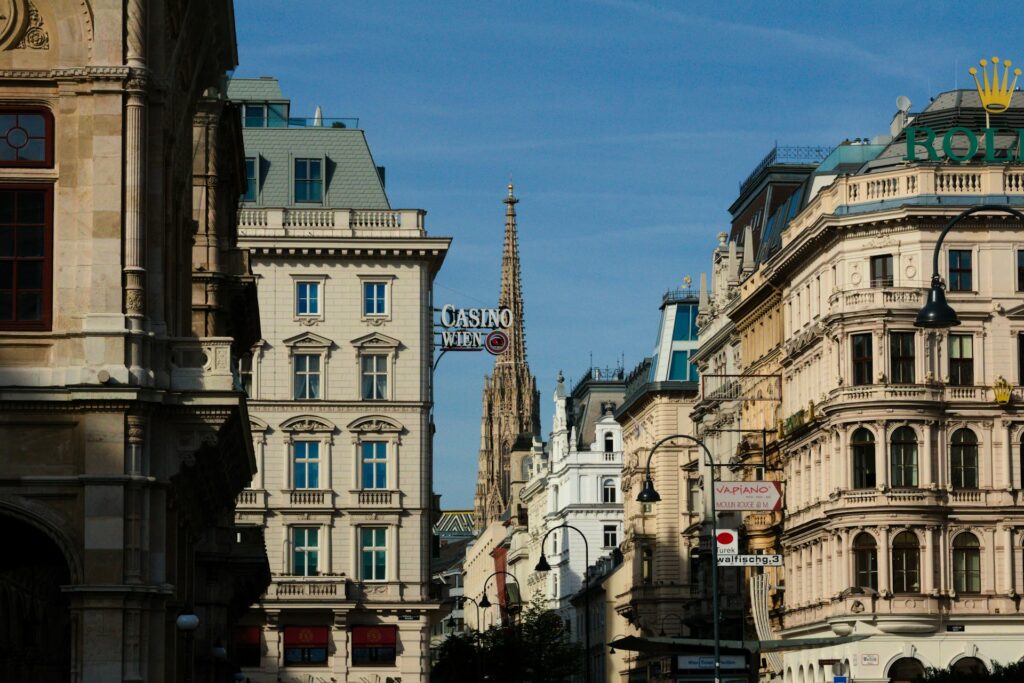
Much of the medieval pattern of streets and squares in the first district has survived into the present, even where the buildings facing them have not. Blutgasse, Schönlaterngasse, Griechengasse and Bäckerstrasse are the lanes where that scale is easiest to feel — narrow, kinked, opening into courtyards. Am Hof and Judenplatz are two of the key medieval squares in this part of the old town, both now ringed by later facades; Am Hof was the Babenberg ducal residence before the Habsburgs moved to a new castle, after which it became a market.
The catch is that the connection between these places is invisible without someone pointing it out. The individual medieval fragments are scattered and mostly hidden behind later frontages, and what ties them together is the shape of the public space rather than anything you can see on a plaque. That’s the gap our self-guided audio tour fills: this article tells you which doors to go through, while the tour connects several of these central medieval stops and supplies the historical narrative between them.
Access at a Glance
By this point the pattern is fairly simple: the lanes are always available, the churches are opportunistic visits, and the museums are the places you can actually plan around. Here’s the whole set in one place.
| Site | What it is | Access |
|---|---|---|
| St Stephen’s Cathedral | The Gothic centrepiece, from the twelfth century onward | Free general entry; the sightseeing route is ticketed, towers and catacombs extra |
| Museum Judenplatz | Excavated foundations of the medieval synagogue | Ticketed; closed Saturdays |
| Ruprechtskirche | Vienna’s oldest surviving church | Free; short and irregular hours |
| Maria am Gestade | Fourteenth-century Gothic, with a distinctive openwork spire | Free; limited hours |
| Minoritenkirche | Fourteenth-century Gothic hall church | Free |
| Deutschordenskirche and Treasury | Church of the Teutonic Order, with a small ticketed treasury | Church free; treasury ticketed, limited days |
| Virgilkapelle | Thirteenth-century chapel under the U-Bahn station | Ticketed, Wien Museum; currently closed |
| Neidhart Festsaal | Oldest secular murals in Vienna, early fifteenth century | Ticketed, Wien Museum; currently closed |
| The old-town lanes | Blutgasse, Schönlaterngasse, Griechengasse, Bäckerstrasse | Free, always open |
What’s Near What
This is a cluster, not a series of trips. Judenplatz and Am Hof are adjacent; Ruprechtskirche and Maria am Gestade sit towards the Danube Canal end of the old town; the Deutschordenskirche is beside St Stephen’s.
Museum Judenplatz needs about an hour, while the churches are short visits. Half a day covers the cluster comfortably with one paid interior.
Practicalities
The oldest layer keeps irregular hours, partly because much of it still belongs to working churches rather than to museums.
- Church hours are the weak point. These are working churches, not museums. Hours are short, irregular, and can vanish for a service or a funeral. Build the walk around the exteriors and treat interiors as a bonus, with one exception: Museum Judenplatz is a real museum and can be planned around. Don’t assume you can walk into every church when you arrive.
- Saturday is the least useful day for this particular itinerary, because Museum Judenplatz is closed.
- Dress and behaviour. Dress respectfully, follow the photography rules posted at each church, and don’t sightsee during a service.
- Cost. You can see most of this from outside, and Ruprechtskirche, Maria am Gestade, the Minoritenkirche and the Deutschordenskirche are free to enter, as is general entry to St Stephen’s. What costs money: Museum Judenplatz, the Teutonic treasury, and the cathedral’s sightseeing route, towers and catacombs. The budget guide covers what else in Vienna costs nothing.
- Accessibility. The lanes are cobbled and uneven. Museum Judenplatz is wheelchair accessible and has a stairlift down to the excavations. The Neidhart Festsaal is not accessible with a wheelchair or pushchair; the Virgilkapelle is, via the U-Bahn station lifts.
- Where the rest of it went. Much of Austria’s surviving medieval panel painting and sculpture isn’t in the old town at all — it’s in the medieval collection at the Lower Belvedere, a tram ride from the centre and a useful companion to a walk like this one.
If you want to book anything ahead, the medieval sites here aren’t where you need to: Museum Judenplatz sells at the door and the churches don’t sell tickets at all. The places worth booking are the bigger museums — the Kunsthistorisches Museum, whose Kunstkammer holds the medieval and Renaissance treasury pieces, and the Belvedere.
GetYourGuide
Museum tickets for the rest of Vienna
The medieval sites in this guide are cheap or free and sold on the door. Where booking ahead genuinely saves time is the big ticketed museums and palaces — the Kunsthistorisches, the Belvedere, Schönbrunn — which is also where much of Vienna’s medieval art actually ended up.
See tickets and tours in Vienna →Common Mistakes
Medieval Vienna is mostly a matter of noticing rather than visiting, and the things you’re meant to notice are unusually easy to walk straight past.
- Going into the cathedral catacombs expecting mainly medieval Vienna. Most of what you walk through relates to burials after 1732, though the medieval Ducal Crypt is part of the complex.
- Treating the churches as museums with reliable hours. They aren’t. Ruprechtskirche in particular relies on volunteers to stay open, and its hours change at short notice.
- Judging by the facades. Street frontages in the old town are mostly later work; medieval fabric is often behind them.
Continue Exploring
- Walking Tour of Vienna — how the first district joins up on foot.
- St Stephen’s Cathedral — towers, catacombs and what the ticketed route actually includes.
- Best Museums in Vienna — where the medieval collections ended up.
Frequently Asked Questions
What’s left of medieval Vienna?
Much of the street pattern of the first district, several Gothic churches, the excavated synagogue foundations under Judenplatz, and fragments inside later buildings. No continuous medieval wall survives above ground; the later fortifications that replaced it were demolished in the nineteenth century.
What is the oldest surviving church in Vienna?
Ruprechtskirche is generally regarded as Vienna’s oldest surviving church. Tradition dates its founding to 740, scholarship favours the early ninth century, and the oldest surviving fabric is twelfth-century.
Can you visit the medieval synagogue?
Yes — the excavated foundations are the centrepiece of Museum Judenplatz, open Sunday to Friday and closed Saturdays.
Are the cathedral catacombs medieval?
Partly. Most of the burial chambers date from after the graveyard closed in 1732, but the complex includes the medieval Ducal Crypt with Rudolf IV, who died in 1365.
What is the Virgilkapelle?
A thirteenth-century chapel directly beneath the Stephansplatz U-Bahn station, buried in the eighteenth century and rediscovered in 1973 during subway construction. It’s ticketed, run by the Wien Museum, and currently closed for restoration.
How much does medieval Vienna cost to see?
The lanes, the squares and the smaller churches listed here are free, as is walking into St Stephen’s. Museum Judenplatz is around €15; the Teutonic treasury and the cathedral’s ticketed areas cost extra.
How long do you need?
Half a day for the cluster with one paid interior. Two hours for the essentials.
Disclosure: this article contains affiliate links. The TouringBee audio guide is our own product, and links to GetYourGuide may earn us a commission if you book through them. Prices and opening hours are those published at the time of writing — check before you travel. The price to you is the same either way.