
No products in the cart.

Paris in Winter: Is It Worth Visiting? Best Things to See and Do
Long evenings, warm cafés and quiet museums: is Paris worth visiting in winter, what to see, what to pack and what to do when it rains.
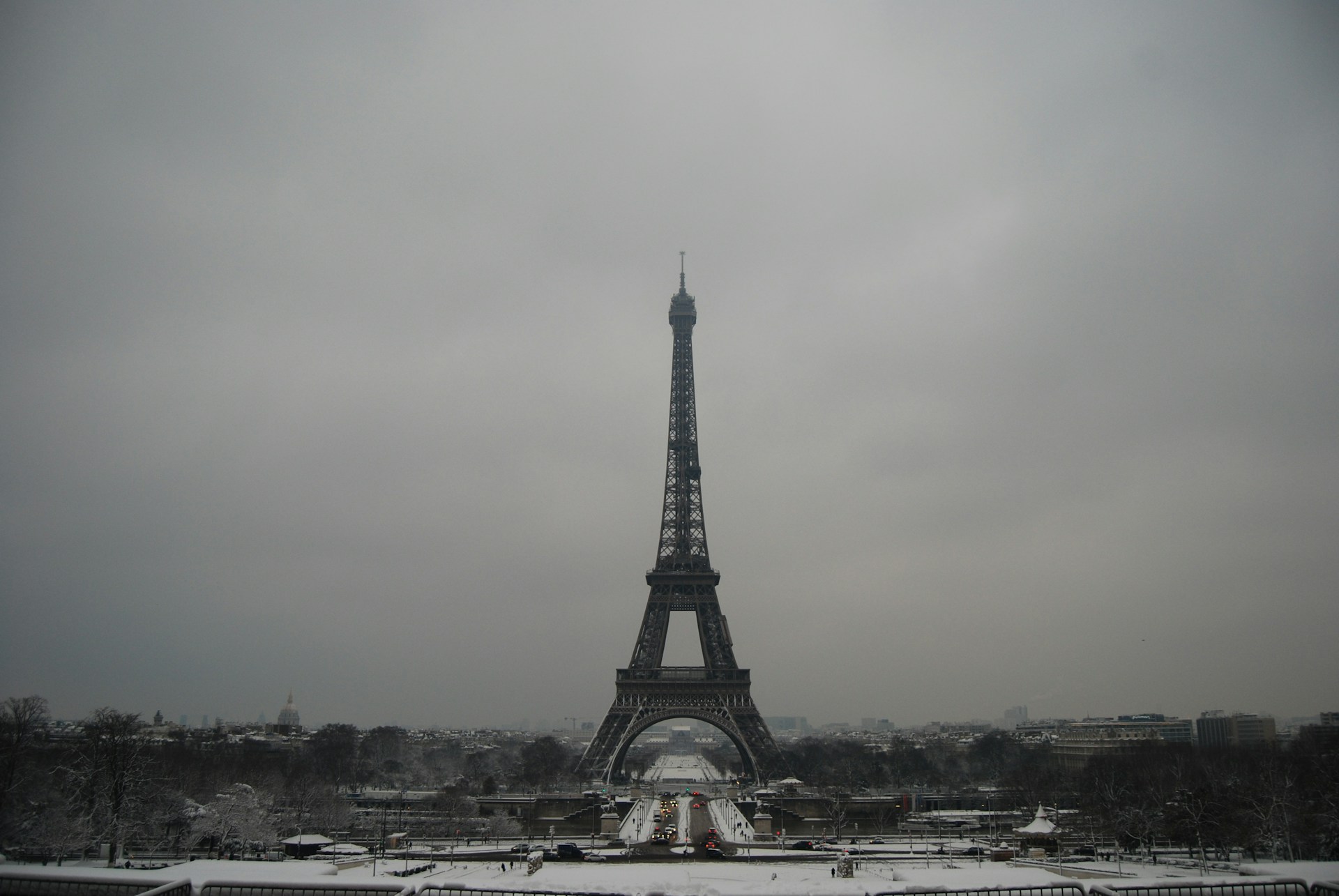
Long evenings, warm cafés and quiet museums: what winter Paris is really like, and how to plan it.

Paris in winter is a city of long evenings, warm cafés, and short walks. There’s less daylight, rain is far more likely than snow, and you’ll need to plan your days differently. In return, the lights come on before dinner, the smaller museums have room to breathe, and Montmartre can be as quiet as a village in the morning.
People come in December for the lights and Christmas markets, in January for museums and the sales, and in February for slow, unhurried walks. Whichever month you pick, a self-guided audio walk from Notre-Dame to the Eiffel Tower is an easy way to fill a short winter day: you set the pace, and you can duck into a café whenever the drizzle starts.
Is Paris worth visiting in winter?
Yes, if museums, food, architecture, and the city after dark are what draw you. Winter is a harder sell for anyone picturing gardens in bloom, café terraces, and long riverside strolls before sunset.
| Winter upsides | Winter downsides |
|---|---|
| Lights and shop windows glow before dinner | Short days, especially in December |
| After the holidays, flights and hotels are often cheaper | Bare gardens, and some fountains are off |
| Montmartre and the residential neighborhoods are quieter | Wet cobblestones and slippery steps |
| Cafés and tea rooms become part of the itinerary | The big museums and the Eiffel Tower still have lines |
That last point is worth remembering: even in January, the most popular museums and viewpoints can have long lines, so timed tickets matter in winter too.
Paris under glass
For more than two centuries, Paris has had its own answer to rainy days. Around 1800, the city began building covered passages — glass-roofed arcades lined with shops, cafés, and bookstores, where people could stroll without minding the rain or the mud in the streets. One of the oldest, the Passage des Panoramas, opened in 1799; the Galerie Vivienne, with its mosaic floors, followed in the 1820s. They’re still open, and on a wet day they’re still a reliable refuge.
It’s easy to combine the Galerie Vivienne with the Passage des Panoramas and the Passage Jouffroy in a single walk from the Palais-Royal to the Grands Boulevards. There are a few minutes of open street between them, and the arcades aren’t heated, but they keep the rain off.
December, January, and February: three different trips
December is the month of lights, window displays, and Christmas markets. The illuminations go on in late November, and after December 19, when French schools let out for the holidays, demand for tickets and restaurant tables climbs noticeably. The last night of the year draws hundreds of thousands of people to the Arc de Triomphe.
January is quieter. Decorations come down by mid-month, bakeries fill their windows with the galette des rois, a traditional French Epiphany cake, and the stores start their sales. By February, the holiday festivities are over, and the month belongs to exhibitions, cafés, long lunches, and Valentine’s Day. Outside the school break, hotels are often cheaper than in December. A trip then feels nothing like a December one.
Weather: rain matters more than snow
Winter daytime temperatures in Paris usually hover around 39–46°F (4–8°C). Expect plenty of gray skies, damp weather, and wind along the Seine. There are frosty days and almost springlike ones, but long hard freezes are rare. Still, a few hours in a cold drizzle can feel just as miserable as a much lower temperature. Snow is unusual and tends to melt fast, but crisp, clear days do happen — the kind when you can sit in the sun in the Tuileries in a winter coat.
One couple got the full range in a single January week: snow, slush, a downpour, and sunshine. Their biggest mistake, they said, was sneakers. By lunchtime they couldn’t feel their feet, and they ended up buying boots in Paris.
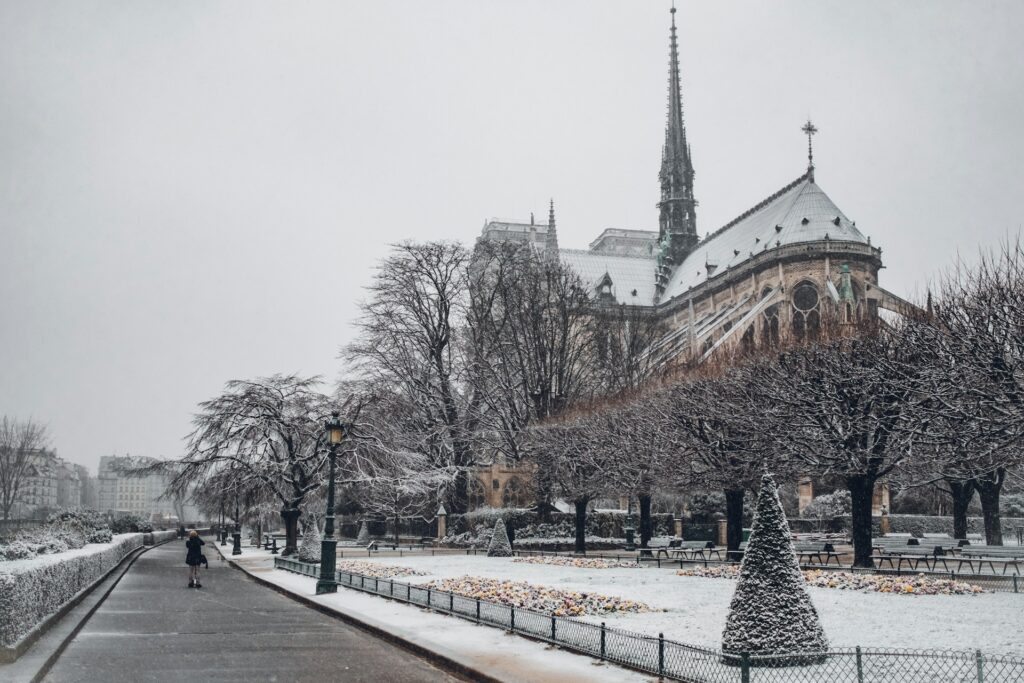
What to pack:
- Waterproof shoes with a good grip. Tall boots aren’t necessary, but there will be plenty of stairs and cobblestones.
- Layers instead of one heavy jacket. Museums, the metro, and department stores are warm, and a sweater is easier to take off than a parka.
- A windproof coat or jacket. On a busy sidewalk, a hood is easier to manage than an umbrella.
- A scarf, gloves, and a spare pair of socks. Gloves come in handy at evening markets and in outdoor lines.
Where to go when it’s cold
In winter, museums, churches, department stores, and cozy cafés become especially appealing.
Museums work in any weather, but their closing days differ: the Louvre is closed on Tuesdays, the Musée d’Orsay and the Carnavalet on Mondays. Evening hours are especially handy in winter. The Louvre stays open until 9 p.m. on Wednesdays and Fridays and the Orsay has late hours on Thursdays, so daylight can go to the streets and darkness to the galleries. If the Louvre is on your list, book a timed entry in advance.
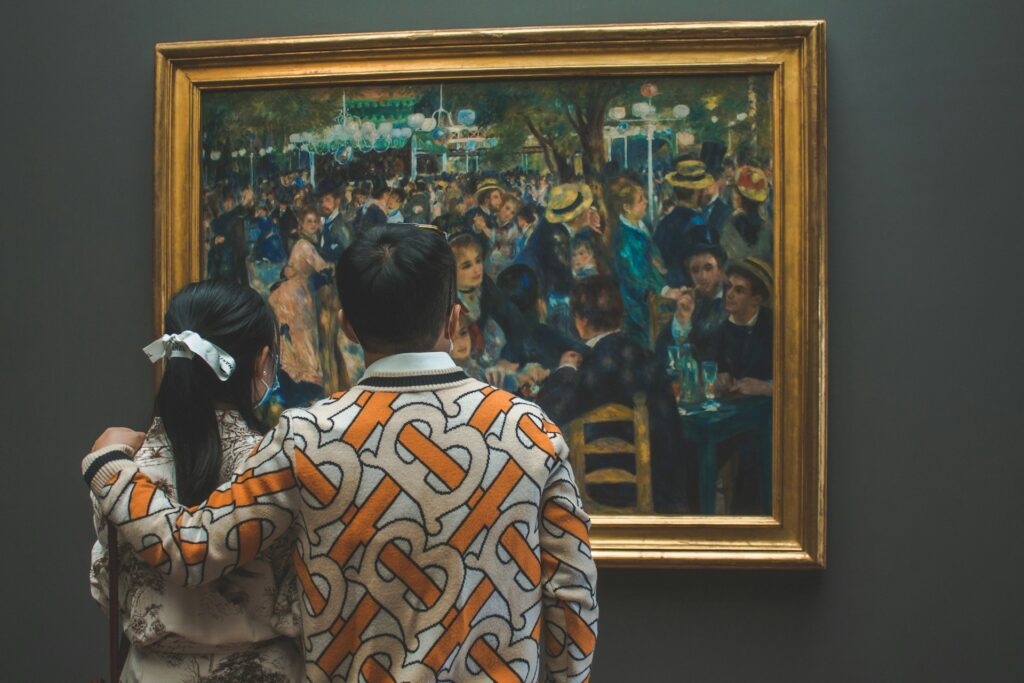
Cathedrals and churches make good half-hour stops between walks. Notre-Dame has reopened after its restoration, Sainte-Chapelle is worth saving for a sunny day for the sake of its stained glass, and Saint-Sulpice and Saint-Eustache are fine places to duck into and warm up.
The department stores on Boulevard Haussmann are worth a visit even without shopping. The stained-glass dome of Galeries Lafayette impresses people who only came in to look, and the free rooftop terrace has a panorama of the city (it closes in rain and high wind). On the Left Bank, La Grande Épicerie, the food hall of Le Bon Marché, can stand in for an entire food walk on a wet day.
For an evening indoors, head to one of the Latin Quarter’s old art-house movie theaters: films marked VO are shown in their original language, often English with French subtitles. Or go to a church concert, a good way to fill an evening after an early sunset.
Winter walks: where to go on a clear day
In the cold, it’s easier to walk in stretches of about two hours and duck into a café or museum in between. So the best neighborhoods are the ones where both are a few steps away.
Île de la Cité and Île Saint-Louis are a great choice for a clear, cold morning. The route is compact and easy to cut short if needed.
Montmartre in winter looks even more like an old village on a hill than it does in summer. Place du Tertre has fewer restaurant tables, and the bare trees open up views. The hill deserves a whole morning: ride the funicular or take the stairs up to Sacré-Cœur, cross Place du Tertre, and wander down toward Pigalle. After rain the cobblestones get slick, so take your time on the way down.
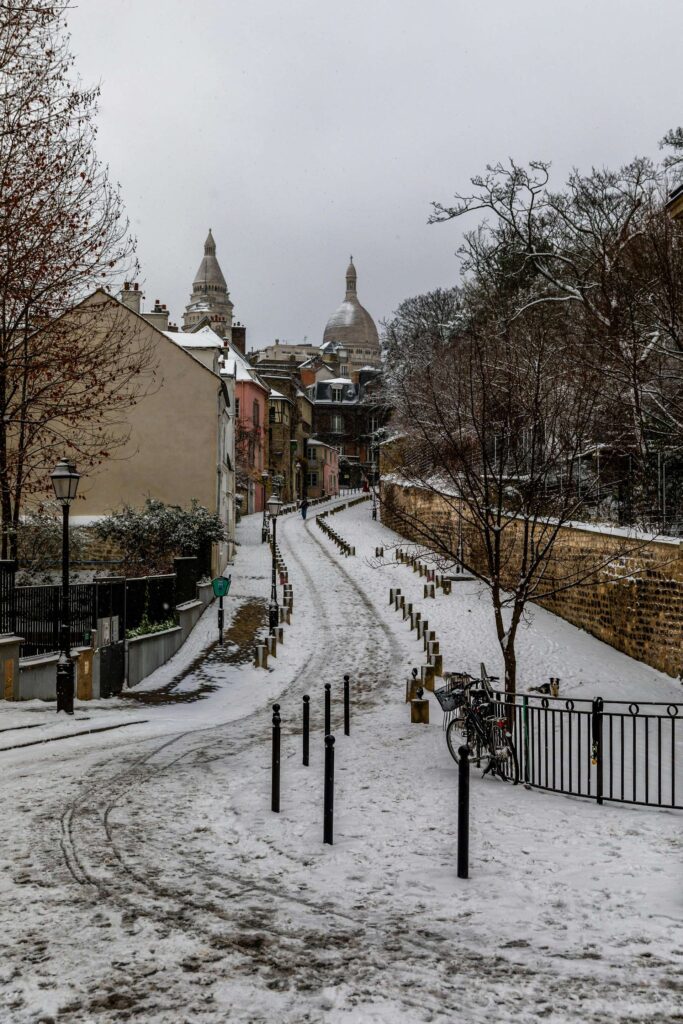
The Marais works in any weather, with narrow streets, mansion courtyards, Place des Vosges, and half a dozen museums within walking distance. Saint-Germain is for walking from bookstore to pastry shop; early on a Sunday its streets are nearly empty. All these neighborhoods fit neatly into a three-day winter itinerary.
Paris after dark
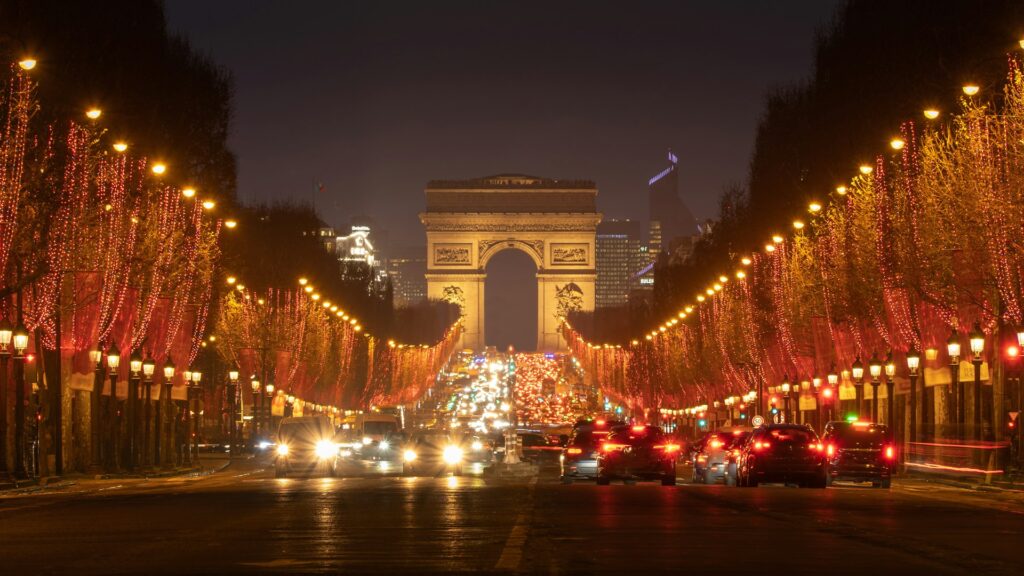
It gets dark early in winter, and that’s the evening’s big advantage. The Eiffel Tower sparkles for five minutes at the top of every hour after nightfall, so you can catch it before dinner instead of at midnight. Seine cruises run year-round, and an evening sailing with an enclosed cabin shows the lit-up city without the wind in your face.
One traveler, embarrassed at first by the “too touristy” open-top bus, ended up calling the evening sightseeing tour the best way to see the lights in an hour without freezing. In December, the Christmas illuminations join the usual ones, and the evening becomes the main event of the day.
Paris after dark
Paris lit up: a one-hour Seine cruise
An evening sailing with audio commentary shows the illuminated city without the wind in your face — a good winter plan once the sun sets early.
See the illuminations cruise →If it rains
A winter day splits nicely into three parts: daylight for streets and façades, midday for museums and lunch, and evening for the lights. For each walk, it pays to have an indoor stop in the same neighborhood, so a downpour doesn’t send you across town.
| If the plan was | And it’s raining |
|---|---|
| Montmartre | Musée de Montmartre and a café on Rue Lepic |
| The Tuileries | The Louvre or the Orangerie |
| The Marais | The Carnavalet, the Picasso Museum, the BHV department store |
| Saint-Germain | Saint-Sulpice, Le Bon Marché, the bookstores |
| Boulevard Haussmann | The department stores and the covered passages |
Before heading out, check that the backup is open on that day of the week.
The practical stuff
- Lines. A timed ticket shortens the wait but doesn’t skip the security check. Tickets to the top of the Eiffel Tower sell out in winter too.
- Holidays. On December 25 and January 1, many museums are closed, the Louvre among them.
- Getting around. The metro is the best way to cut time spent in the cold. Tickets are easy to buy in the Île-de-France Mobilités app. If you’ll be riding a lot, compare a day pass with the cost of single tickets.
- Where to stay. With luggage, check for an elevator. Keep in mind that a French “fourth floor” is what Americans call the fifth, and climbing an old staircase after a long flight can become your most vivid first impression of Paris. Montmartre is charming, but its hills and stairs are hard going with suitcases. In winter, the Marais, Saint-Germain, or the quiet 7th arrondissement are easier.
Winter Paris in five pictures
- The Champs-Élysées in lights, reaching the Arc de Triomphe after dark.
- Hot chocolate in a tea room, thick as a dessert.
- Winter light through the stained glass of Sainte-Chapelle on a clear morning.
- A near-empty Montmartre and the view from the steps of Sacré-Cœur in the blue dusk.
- A morning croissant, enjoyed from a chair in the Tuileries on a sunny, frosty day.
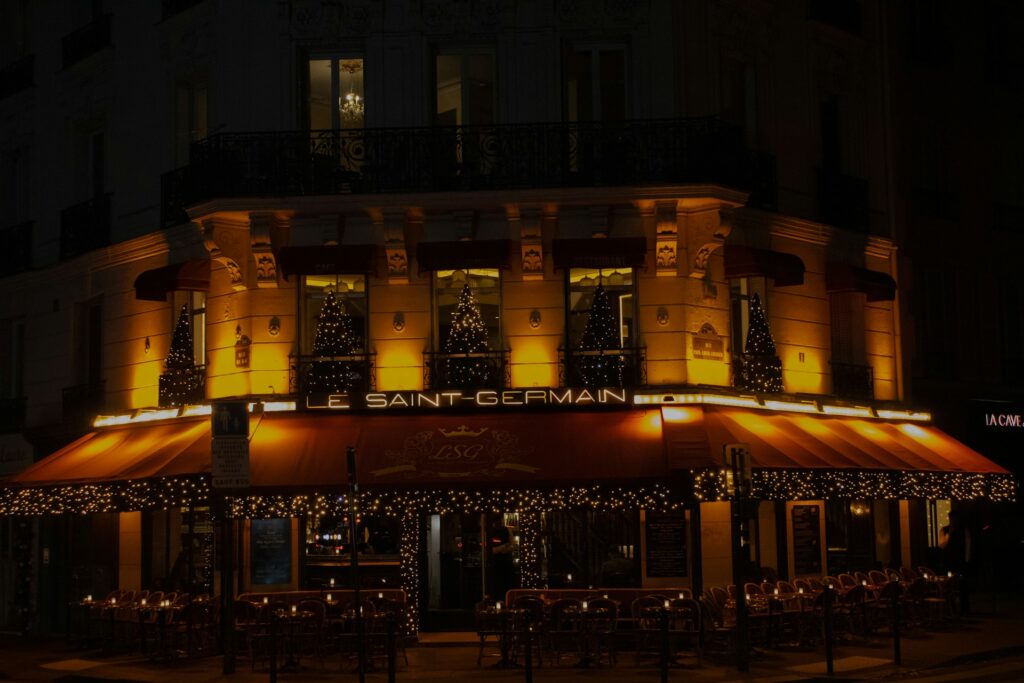
Winter Paris reveals itself gradually — on walks down quiet streets, in museums, at a café table. Travelers who don’t mind the rain see a calmer city than in summer, and maybe one closer to the Paris that Parisians know.

FAQ
Is Paris worth visiting in winter? Yes, if museums, food, architecture and the city after dark are what draw you. Less so if you picture gardens in bloom and long riverside strolls before sunset.
Does it snow in Paris? Rarely, and it melts fast. Rain and gray skies are far more likely, with daytime temperatures around 4–8°C (39–46°F).
Which museums are closed on which day? The Louvre is closed on Tuesdays; the Musée d’Orsay and the Carnavalet on Mondays. Many museums are closed on December 25 and January 1.
What should I pack? Waterproof shoes with grip, layers, a windproof coat, a scarf, gloves and spare socks.
Continue exploring
- Our self-guided audio walk through central Paris, from Notre-Dame to the Eiffel Tower.
- Louvre entry ticket with Mona Lisa audio guide on GetYourGuide.
- Illuminations river cruise for the lit-up city in an hour.
Disclosure: this article contains affiliate links to the TouringBee audio guide, a product of the site’s own company, and to GetYourGuide; we may earn a commission on purchases made through them.